Researcher’s Introduction to the Revival of Hadith al-Wilayah in ʿAbaqāt al-Anwār
In the name of Allah, the Most Gracious, the Most Merciful
Praise be to Allah, Lord of the worlds, and blessings and peace be upon the master of the prophets and messengers and his pure and purified progeny, and the curse upon all their enemies. The Messenger of Allah (peace and blessings of Allah be upon him and his family) said: “ʿAlī is from me and I am from him, and he is the guardian of every believer after me.”
Hadith al-Wilayah is the third hadith that ʿAbd al-ʿAzīz al-Dihlawī addressed in Chapter Seven of the book Tuḥfah-yi Ithnā ʿAshariyyah. Since this hadith is one of the explicit texts proving the immediate succession and Imamate of Amīr al-Muʾminīn (peace be upon him), he found no alternative but to deny and invalidate it.
Before al-Dihlawī, Ibn Taymiyyah, who is the Shaykh al-Islām of the Sunnis, had undertaken to declare this hadith false; for he had correctly realized that there was no possibility of any justification or interpretation in its explicit indication, and if this hadith were established, the flood of destruction would run through the foundation of the non-solid edifice of the Saqīfah school. Therefore, with certainty and decisiveness, he set out to deny this noble hadith. Although some other opponents had taken the path of interpretation regarding the indication of this hadith, al-Dihlawī too brought those feeble interpretations in his own work.
The Ferdaws-dwelling Allamah Mīr Ḥāmid Ḥusayn—upon him be the showers of mercy as long as the earth is illuminated by the light of the two moons—in response to al-Dihlawī’s claim, which had been raised in less than half a page, wrote a voluminous volume comprising 585 lithographic pages. In this volume, not only al-Dihlawī’s objections, but also the objections of other scholars of his school, such as Ibn Taymiyyah, Ibn Ḥajar al-Makkī and others, have been answered in detail.
At the beginning, he presents an introduction entitled “Statement of the Repulsiveness of Denying the Virtues of Amīr al-Muʾminīn (peace be upon him).” In this introduction, he explains that the unsatisfactory practice of the predecessors of this group had been the concealment and denial of the virtues of Amīr al-Muʾminīn (peace be upon him). Al-Dihlawī too, following his wicked predecessors, entered the thorn-filled valley of Nasb and denial.
After this introduction, in response to al-Dihlawī’s claim regarding the invalidity of this hadith, he presents one hundred arguments establishing Hadith al-Wilayah and refuting its invalidation. In these one hundred arguments, he explains that great Sunni hadith scholars such as Abū Dāwūd al-Ṭayālisī, Abū Bakr ibn Abī Shaybah, Aḥmad ibn Ḥanbal, Abū ʿĪsā al-Tirmidhī, al-Nasāʾī and others have transmitted this noble hadith; and some of them, such as Ibn Abī Shaybah, Ibn ʿAbd al-Barr, al-Mizzī, al-Suyūṭī and others, have judged it authentic. In addition, according to Sunni rijāl scholars, every single narrator of this hadith is trustworthy, declared upright and authenticated.
Al-Dihlawī based his claim regarding the invalidity of Hadith al-Wilayah on the presence of a person named “Ajlaḥ ibn ʿAbd Allāh al-Kindī” in its chain of transmission, and said: “Because Ajlaḥ occurs in its chains, and he is a Shīʿī accused in his narration.” Unaware that Hadith al-Wilayah has also been transmitted through several other chains in which Ajlaḥ does not occur, and that too in a famous and well-known book such as Musnad Aḥmad!
The late Mīr Ḥāmid Ḥusayn responds by stating that, apart from the existence of other chains for this hadith, the mere presence of Ajlaḥ does not harm the authenticity of this narration; for being a Shīʿī, according to the terminology of the early Sunnis, does not constitute grounds for disparagement and criticism, to the extent that some great figures of this group, such as al-Nasāʾī, who is among the compilers of the Six Canonical Books, have themselves been attributed to Shiʿism. On the other hand, a number of Sunni rijāl scholars, such as Yaḥyā ibn Maʿīn, ʿAmr ibn ʿAlī Fallās, Aḥmad ibn ʿAbd Allāh al-ʿIjlī, Yaʿqūb ibn Sufyān al-Fasawī and others, authenticated Ajlaḥ; moreover, he is also among the narrators of the Sunans of Abū Dāwūd, al-Tirmidhī, al-Nasāʾī and Ibn Mājah.
After claiming the invalidity of Hadith al-Wilayah, al-Dihlawī, in order to justify the compatibility of the indication of this hadith with the Sunni claim, writes: “Walī is one of the homonymous terms.” But this stratagem is of no avail to him; for although “walī” is a homonymous term, the word “baʿdī” in the hadith is a firm contextual indication that what is intended is wilayah in authority and governance. In response to al-Dihlawī, the very statement of Ibn Taymiyyah suffices: “The wilayah that is the opposite of enmity is not restricted to a particular time.”
Here we understand why some of al-Dihlawī’s fellow thinkers, such as Ḥusām al-Dīn Sihāranpūrī and Mīrzā Muḥammad ibn Muʿtamad Khān, resorted to denying the word “baʿdī” in Hadith al-Wilayah, whereas in all hadith sources, Hadith al-Wilayah has been transmitted together with the word “baʿdī.”
Indeed, the indication of Hadith al-Wilayah regarding the immediate succession and Imamate of Amīr al-Muʾminīn (peace be upon him) is so clear and undeniable that it has caused the opponents to fall into bewilderment, agitation, confusion and loss of composure.
An even more absurd interpretation that al-Dihlawī has brought in Tuḥfah is restricting the wilayah of Amīr al-Muʾminīn ʿAlī (peace be upon him) to the period after ʿUthmān. Now al-Dihlawī must answer whether the Three Caliphs are among the believers or not. If they are among the believers, then the wilayah of Amīr al-Muʾminīn (peace be upon him) over them is established; and if they are not among the believers, then there will remain no room for discussion or debate.
In conclusion, it must be said that Hadith al-Wilayah alone is sufficient and adequate to establish the immediate succession and Imamate of Amīr al-Muʾminīn (peace be upon him), and this volume of the precious book ʿAbaqāt al-Anwār has fulfilled this serious task in the best possible manner; as it is stated in one of the letters of the ʿAbaqāt family:
ʿAbaqāt al-Anwār is in response to the chapter on Imamate of Tuḥfah-yi ʿAzīziyyah, and it is a very extensive and highly esteemed book, which will become 25 volumes like Biḥār. In this book, all the hadiths indicating the Imamate of al-Murtaḍā have been established, and selections from the books of the opponents were personally brought into it by the author, who risked his life, from the libraries of the Sacred Sanctuary of Mecca and Medina—may Allah increase their honor and reverence.
It is a book that if even one volume of it becomes known, the hearts of the Sunnis will be roasted, and if all their people of virtue and knowledge gather together to write a response to even one matter from it, they will be unable to do so. And the hope from the favors of Almighty God and the assistance of Amīr al-Muʾminīn is that the fair-minded opponents, after examining this book, will abandon Sunnism and join the ranks of the people of truth, just as some people became Shīʿah after examining Istiqṣāʾ al-Afhām.
May Allah reward him with the best reward with which He rewards the sincere strivers, and resurrect him with his pure forefathers, especially our master Amīr al-Muʾminīn, upon him and his progeny be the peace of the Judge of the Day of Judgment, and settle him in the highest degrees of Paradise with the martyrs and the truthful, by His grace and bounty, for He is the Most Merciful of the merciful.
The Participation of Nāṣir Ḥusayn
By referring to the drafts of Hadith al-Wilayah, it became evident that Allamah Nāṣir Ḥusayn, known as Nāṣir al-Millah (d. 1361 AH), the eldest son of Allamah Mīr Ḥāmid Ḥusayn—may Allah’s pleasure be upon them both—had an effective participation with his scholarly father in compiling this work.
At the beginning of one of the drafts, the following is written:
“This is the second part of the third volume of the Second Manhaj of the book ʿAbaqāt al-Anwār fī Imāmat al-Aʾimmah al-Aṭhār, devoted to mentioning the hadith ‘Indeed, ʿAlī is from me and I am from him, and he is the guardian of every believer after me.’
I began comparing it on the twenty-second of Shaʿbān al-Muʿaẓẓam of the year 1299 AH after the Hijrah of the Prophet (peace and blessings of Allah be upon him and his family)…
And I, the poor Nāṣir Ḥusayn…”
And on the final page of this same draft, the following expression is written:
“Draft of the takhrīj of Hadith al-Wilayah, without biographical notices and some with biographical notices, from Yūsuf Kanjī to the last rank, from which the fair copy was made in the handwriting of Mīr Maʿṣūm ʿAlī.
Nāṣir Ḥusayn, may he be forgiven.”
Also, throughout these drafts, the handwriting of the late Nāṣir Ḥusayn is repeatedly seen.
Introduction to the Lithographic Edition of Hadith al-Wilayah
This work has been researched on the basis of the lithographic edition of the Hadith al-Wilayah volume of ʿAbaqāt al-Anwār. This volume was printed in 1303 AH, three years before the death of Allamah Mīr Ḥāmid Ḥusayn—may Allah’s mercy be upon him—at the Jaʿfarī Press in the city of Lucknow, in 585 pages.
On the first page—which apparently was arranged by the printing press—the verse “Allah is the Guardian of those who believe; He brings them out of darknesses into the light” is written in an inscription at the top of the page. Following it is a text praising and commending Allamah Mīr Ḥāmid Ḥusayn, may Allah’s mercy be upon him, and at the end the name of the press is mentioned.
“Allah is the Guardian of those who believe; He brings them out of darknesses into the light.”
Praise and gratitude be to Allah that in this blessed and auspicious time, the volume of Hadith al-Wilayah, which is the third volume among the volumes of the Second Manhaj of the esteemed book ʿAbaqāt al-Anwār fī Imāmat al-Aʾimmah al-Aṭhār, authored by the remover of grief, heir to the آثار of the Imams, the luminous pole who unveiled the darkness of rust from the landmarks, the divine scholar whom no blame of a blamer in the way of Allah affects, the peer of his age and the unique one of his era, the Allamah of his time and the leader of his age, the manifest proof, the clear standard, the guide to righteous action, the guide to profitable virtue, the honor of the expert jurists and mujtahids, the chief of the distinguished and foremost men, the sea of knowledge whose waves surge, the ocean of sciences whose shores are turbulent, the clarifier of obscure subtleties, the revealer of the secrets of realities, whose nobility the eloquent tongues of the ages are incapable of describing, whose greatness penetrating minds are unable to comprehend, our refuge and the refuge of the two horizons, our master Sayyid Ḥāmid Ḥusayn—may Allah perpetuate the clouds of his abundant beneficence pouring down, the lights of his instruction shining brightly, the abodes of knowledge flourishing and radiant through his critical editions, and the gardens of perfection fresh and verdant through his investigations—was printed at the Jaʿfarī Press in Lucknow in the year 1303 AH.
The dimensions of the lithographic copy are 21 by 31 centimeters. The four sides of the pages are ruled and contain the text within them. The page numbers are placed at the top and in the middle of the page, and on most pages, on both sides of the number, there are running heads and titles.
Research Method
The research of this work was carried out as follows:
At first, the typed text was carefully collated with the lithographic edition.
The page numbers of the lithographic edition have been placed before the first word of each page and within square brackets [].
The spelling of some words has been given according to the orthography commonly used today. For example, words such as “درین” and “برینکه” have been written as “در این” and “بر اینکه.” Following the same procedure, the preposition “بـ” has been written separately from the following word according to contemporary orthography. For example, “باختصار” has been written as “به اختصار.”
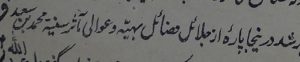
In cases where reading a word in the context of the sentence together with the suffix “ای” was correct, this suffix has been added to the end of the word without noting its addition to the lithographic edition. For example, the sentence “در اينجا پاره از جلائل فضائل بَهيّه و عوالى مآثر سَنيّۀ محمّد بن سعدِ كاتبِ عالىمناقبِ والامناصبِ جليل المراتب مذكور مىشود.” has been given as: “در اينجا پارهای از جلائل فضائل بَهيّه و عوالى مآثر سَنيّۀ محمّد بن سعدِ كاتبِ عالىمناقبِ والامناصبِ جليل المراتب مذكور مىشود”.
It should be noted that in some texts from that period, including the lithographic edition of ʿAbaqāt, in order to indicate such a suffix, the letter “ه” at the end of the word was written with a small “ی”, such as “پارۀ”. For example, the aforementioned expression appears in the lithographic edition in this form:
English Translation
- The meanings of difficult and unfamiliar words in Arabic and Persian expressions have been documented. If the word occurs in an Arabic expression, reference has been made to Arabic dictionaries, and if it occurs in a Persian expression, reference has been made to Persian lexicons.
- Verses, hadiths, and quotations have been sourced, except for cases in which their sources could not be accessed.
- The hadiths of the Infallibles, peace be upon them, in the text and footnotes have been placed between these marks: “…”. Hadiths whose attribution to an Infallible is incorrect, or which are strongly presumed to be among the fabricated reports, are excluded from this rule.
- In order to distinguish the text from the commentary in sharḥ-mizajī books, the main text has been reproduced in bold type.
- Hadiths and texts quoted from other sources have been carefully collated with the text of the lithographic edition and the source, and differences between the text and the source have been noted; in such a manner that additions in the text over the source have been placed between these signs <…>, and additions in the source over the text have been placed between parentheses (…). Differences that consist of variation in words or expressions have been mentioned in the footnotes.
- In cases of disagreement between the lithographic edition and the source, sometimes the expression or word found in the lithographic edition is correct, sometimes the opposite is true, and sometimes neither what appears in the lithographic edition nor what appears in the source is correct. In all these cases, the correct expression has been placed in the text, and the difference has been noted in the footnote.
This difference is more frequent in the names of persons. In such cases, an effort has been made, by referring to biographical sources and other early hadith and historical sources, to establish the correct form of the name, except where the narrator’s name could not be accessed, or where the name itself appears differently in other sources and determining the correct form was not possible. In such a case, only the difference between the form found in the lithographic edition and that of the source has been noted in the footnote.
- In sourcing the works cited by the author, in a small number of cases, two editions have been used. The second edition has sometimes been printed and sometimes manuscript. Of course, reference to the second source, contrary to the prevailing practice and the initial rule, has been made for the purpose of noting a particular point.
For example, in sourcing the book Firdaws al-Akhbār, the edition of “Dār al-Kitāb al-ʿArabī” was taken as the basis of the work, because Musnad al-Firdaws has also been printed within that edition. ʿAllāmah Mīr Ḥāmid Ḥusayn, may God’s pleasure be upon him, cites a narration from Firdaws al-Akhbār which is not found in this edition but is found in the edition of “Dār al-Kutub al-ʿIlmiyyah”; therefore, in this case, reference has been made to the edition of “Dār al-Kutub al-ʿIlmiyyah.”
The method of arranging such sources in the bibliography is as follows: first, the source that was used according to the initial rule is introduced, and then the source to which reference was exceptionally made is introduced.
- Reference to a single-volume book is made as follows: Ṭabaqāt al-Ḥuffāẓ: 50.
- Reference to a single-volume book with the hadith number is made as follows: Kanz al-ʿUmmāl: 50/33. (That is, page 50, hadith 33.)
- Reference to a single-volume book with the entry number is made as follows: Taqrīb al-Tahdhīb: 70/number 40.
- Reference to a book consisting of two or more volumes is made as follows: Siyar Aʿlām al-Nubalāʾ 2: 50.
- Reference to a book consisting of two or more volumes with the hadith number is made as follows: Musnad Aḥmad 2: 50/33. (That is, volume 2, page 50, hadith 33.)
- Reference to a book consisting of two or more volumes with the entry number is made as follows: al-Kāshif 2: 70/number 40.
- All the contents of the margins of the lithographic edition have been recorded. These marginal notes are of various types:
First: In the margin, expressions accompanied by the symbol “فـ” which means “fāʾidah” have been included. These fawāʾid are, in a few cases, intended to highlight and draw attention to an expression in the text, such as:
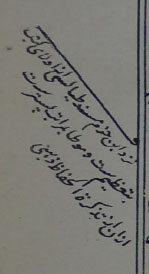
This fāʾidah is placed above “Musnad al-Ṭayālisī” and draws attention to it:
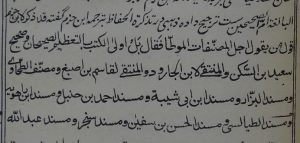
In most cases, these fawāʾid indicate the title of the discussion that follows, such as:
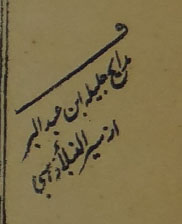
During the research process, these fawāʾid, as well as the titles appearing in the running headers, have been used in selecting the headings. If these fawāʾid have not been used in the headings, they appear in the footnote in the following form:
فـ: مدائح جلیلۀ ابن عبد البرّ از سیر النبلاء ذهبی.
The fawāʾid that have been regarded as headings and incorporated into the main text are not accompanied by “فـ:”.
Second: In the lithographic edition, the references to some quotations have been written in the margins. Sometimes, the page number and the total number of pages of the referenced copy have also been given, in the following manner: a line has been drawn, then the page number has been placed above it and the total number of pages of the copy below it:

In some cases, in addition to the page number, the name of the chapter or entry is also mentioned:
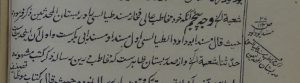
In some cases, only the name of the chapter or entry is mentioned:

In one instance, the title of the discussion appears in an ornate frame as follows:
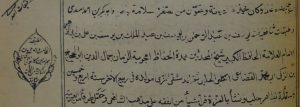
Since all quotations have been sourced and references have been provided to critical editions, there was no need to mention these marginal notes, and therefore they have been omitted.
Third: In some of the marginal notes, an explanation of a word or expression is given. These marginal notes have been indicated by placing a number above a word or expression in the text, and in the margin of the copy, an explanation corresponding to that number has been provided.
If these explanations have been quoted from a book, the name of the book appears at the end of the marginal note. In most cases, the name of the source is given in full, and in some cases it is given in abbreviated form. These abbreviations are as follows:
The abbreviation “ق”: for the book al-Qāmūs al-Muḥīṭ. For explaining Arabic vocabulary, this book, as well as Itḥāf Dhawī al-Albāb, have been used more extensively.
The abbreviation “م”: for the book Muntahā al-Arab by Ṣafīpūrī. In most cases, this book has been used for translating words from Arabic into Persian. This abbreviation occurs only once, and in the other cases the name of the book is given in full.
Some explanatory marginal notes appear between the lines. These marginal notes have also been included in the footnotes.
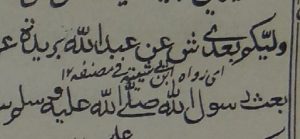
At the end of many of these marginal notes, the number “۱۲” or “۱۲ منه” appears. Tāj al-ʿUlamā Sayyid ʿAlī Muḥammad ibn Sulṭān al-ʿUlamā (d. 1312 AH), the grandson of ʿAllāmah Ghufrān-Maʾāb (d. 1235 AH), who was one of the great scholars of India and a contemporary of ʿAllāmah Mīr Ḥāmid Ḥusayn, may God have mercy upon them, has written the following in explanation of this symbol:
As for the marginal note, they also wrote a number on it, as mentioned previously, but they end it with the number ۱۲, by which they mean “al-ḥadd” (the end), and intend that it is the limit and conclusion of the marginal note. That ۱۲ is a symbol for “al-ḥadd” is apparent; for this is the numerical value of the letters of “al-ḥadd,” because the numerical value of the unpointed ḥāʾ is ۸ and that of the unpointed dāl is ۴, and their sum is ۱۲.
This applies to something other than the munhiyyah. As for the munhiyyah, at its end, along with the aforementioned number — namely ۱۲ — “منه” is written, unlike the others; for in the latter, the name of the annotator is generally written after the aforementioned number. The understood antecedent of the attached pronoun in “منه” is the author of the book. And munhiyyah is derived from “منه” by adding the relational yāʾ at its end, and the tāʾ is for the feminine form, considering that it is an adjective for the marginal note; and all of this is evident. [6]
Fourth: In some cases, relatively lengthy explanations or supporting evidence have been mentioned in the margin for the purpose of clarifying or completing the discussion. Sometimes a specific mark has been placed over a word or expression in these marginal notes, and at the end of the marginal note an explanation of that word has been given. To indicate these cases — which are, in reality, marginal notes upon marginal notes — the asterisk “*” has been used. In this manner, after the word, an asterisk is placed, and after the marginal note has ended, at the beginning of the line, the asterisk is repeated and that explanation is given. If there is more than one instance of a marginal note upon a marginal note within a single marginal note, two asterisks “**” and more have been used.
The asterisk has also been used for the explanations of the researcher concerning the expressions of the marginal notes of the lithographic edition.
Fifth: In some marginal notes, conjectures have been given to indicate the possible occurrence of a textual corruption in the text. In this manner, the symbol “ظ” is written above the relevant word or expression in the text, meaning “ẓāhiran” (apparently), [7] and then the symbol “ظ” is repeated in the marginal note, with the correct or more correct word or expression given beside it. These marginal notes have been reflected in the footnotes. For example:
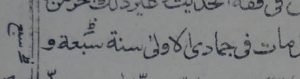
In many cases, the symbol «ظ» is accompanied by «له», which probably means «بدله» (in its place), or it may indicate that the word appearing in the text belongs to the source, whereas apparently the correct reading is the one mentioned in the marginal note.
Sometimes, together with the symbol «ظ», a mark resembling the number «۷» is also drawn, and the word «صحّ» is written after the marginal note. Such cases indicate a possible omission from the text:
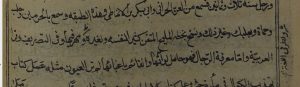
Fifth: In some cases, the copyist mistakenly omitted a word or phrase from the text; subsequently, that omitted passage was restored during the rereading and included in the marginal note. In this manner, its place is marked in the text with a mark resembling the number «۷», and in the marginal note, following the same mark, the omitted passage is given. This type of marginal note is identified in the lithographic edition by the symbol «صح» placed at the end of the passage. For example:
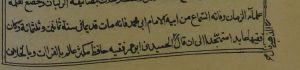
In the research carried out, these cases have been added to the main text, and the omission in the lithographic edition has not been noted.
Sixth: In some marginal notes, a variant reading of the source is indicated; in this manner, the symbol «ن»—which indicates a variant reading—is placed above the passage in question, and in the marginal note, following the symbol «ن», the wording found in another manuscript of the source is written. For example:

In the text, «أمرني» is given, and in the marginal note it is stated that the variant reading is «أوحی إليَّ».
Symbols
The symbols used in the research are as follows:
<> indicates an addition in the lithographic edition over the source.
() indicates an addition in the source over the lithographic edition.
[] indicates additions by the researcher.
م indicates the source.
ح indicates the lithographic edition.
Images of the Manuscripts
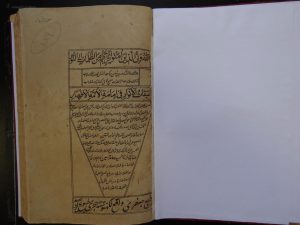
Image of the first page of the lithographic edition
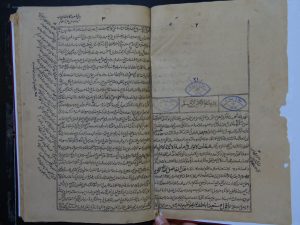
Image of the second and third pages of the lithographic edition
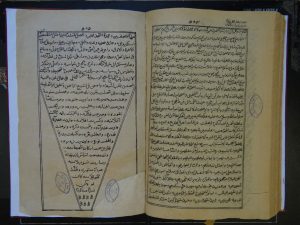
Image of the last page of the lithographic edition
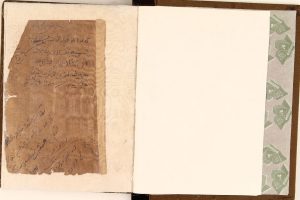
Image of the handwriting of the late Nāṣir Ḥusayn on the first page of one of the collections of drafts of Ḥadīth al-Wilāyah
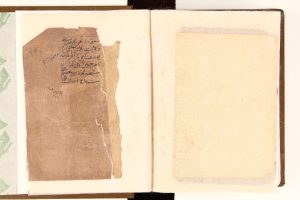
Image of the handwriting of the late Nāṣir Ḥusayn on the final page of the same collection
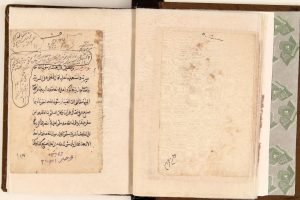
Image of the handwriting of the late Nāṣir Ḥusayn among the drafts of Ḥadīth al-Wilāyah
Acknowledgment and Gratitude
At the outset, I am grateful for the boundless favors of the Peerless Lord, who granted this insignificant servant the opportunity to revive this monumental work, so that my humble name, too, may be included among the servants of His Eminence Amīr, peace of God, the Almighty King, be upon him; may it be that I remain honored with serving this threshold until my final breath!
Thereafter, I extend my utmost thanks and gratitude to all those who assisted this humble servant in this momentous undertaking, especially His Eminence Ayatollah Sayyid Mahdi Nabavi, and my researcher colleagues in the Heritage Revival Unit; namely, Hujjat al-Islams: Mr. Taher Azizvakīli, Mohammad Mahdi Dalir, Mohammad Javad Rajabzadeh, Mohammad Nasiri, and Sayyid Sadeq Hashemi.
I also deem it incumbent upon myself to express my utmost gratitude for the efforts and support of Hujjat al-Islam Dr. Mohammad-Taqi Sobhani, President of the International Congress of Allamah Mir Hamid Husayn, may God’s pleasure be upon him; Hujjat al-Islam Mehdi Esfandiyari, the Scientific Secretary and Director of the Congress’s Works Revival Group; Hujjat al-Islam Ruhollah Kazemi, Deputy for Research of the International Foundation of Imamate; and Hujjat al-Islam Mohammad Farid Ansari Rud-Sari, Deputy Head of the International Foundation of Imamate.
Mojtaba Nazemi Qamshani
6 Mordad 1404 – 3 Safar 1447
Holy Qom
Footnotes
[1] The drafts of Hadith al-Wilayah, retrieval number: 24694, Central Library of the Astan Quds Razavi.
[2] الرَّيْن: الطَّبَع والدَّنَس… الرَّيْن: سواد القلب. Lisān al-ʿArab, 13:193, “Rayn.”
[3] القَمْقام: البحر. The same, 12:494, “Qamm.”
[4] ثَبَجُ كلِّ شيء: مُعظَمُه ووسطه وأعلاه، والجمع: أثباج. The same, 2:219, “Thabaj.”
[5] المِصْقَع كمِنْبَر: البَليغ… یقال: خطيبٌ مِصقَعٌ ومِسقَعٌ ومِسحَلٌ وشَحْشَحٌ، وهو الماهر في الخطبة الماضي فِيها، والجمع: مَصاقِع. Tāj al-ʿArūs, 11:275, “Ṣaqaʿ.”
[6] al-Jawharah al-ʿAzīzah (included in Rasāʾil fī Dirāyat al-Hadīth), 2:459–460.
[7] See: Muʿjam al-Rumūz al-ʿĀmmah, 2:343.
[8] See: the same, 2:587.