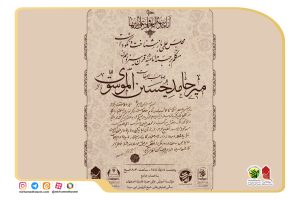
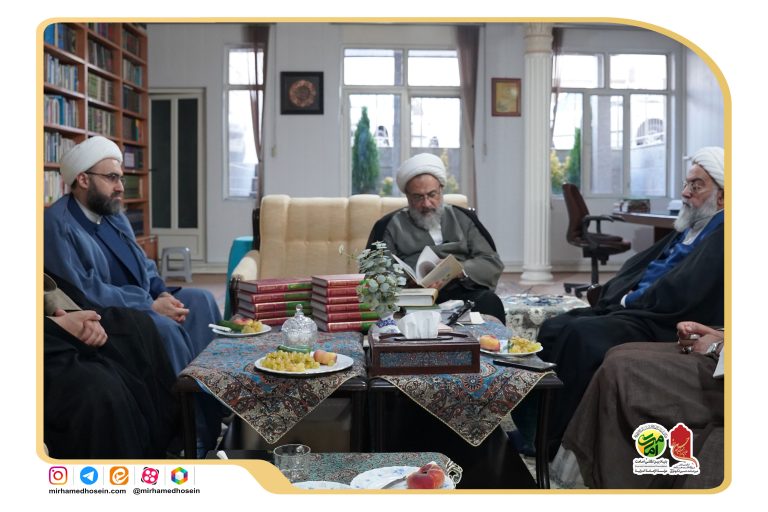
Meeting of the President and Members of the Secretariat of the International Congress Commemorating Allamah Mir Hamed Hussain with Ayatollah Alidoost
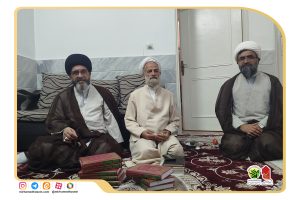
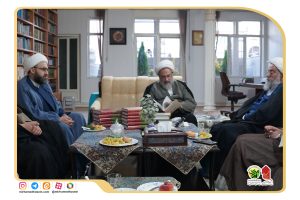
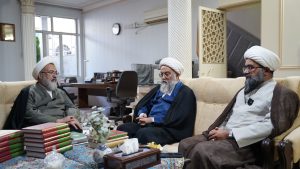
A group of officials from the Secretariat of the International Congress Commemorating Allamah Mir Hamed Hussain Lakhnawi (May Allah sanctify his soul) visited the office of Ayatollah Abolqasem Alidoost, a professor of advanced and kharij-level studies at the Qom Seminary, and met and spoke with him. Hojatoleslam wal-Muslimeen Mohammad Taqi Sobhani, President of the Congress, along with a number of members of the Scientific and Executive Councils, attended the meeting.
At the beginning of the meeting, Hojatoleslam wal-Muslimeen Dr. Rouhollah Kazemi, Secretary of the Congress, presented a comprehensive report on the research and field dimensions of the Congress. Explaining the background of the Lucknow scholarly school and the role of the prominent scholarly families of northern India, including the family of Allamah Mir Hamed Hussain and the family of Allamah Sayyid Dildar Ali Ghufran Ma’ab, he announced that, according to the plans made, the Congress will be held in two sections: one congress centered on the monumental work Mir’at al-Uqul / Imad al-Islam by Allamah Sayyid Dildar Ali Naqvi, and another centered on the great encyclopedia Abaqat al-Anwar and the works of the Abaqat family.
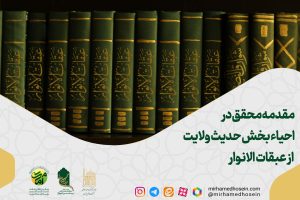
Referring to the difficulties involved in collecting manuscripts and tracing more than 1,200 sources from both sides that are cited in the text of Abaqat al-Anwar, he reported on the preparation and publication of nearly 70 volumes of the works of this family. These include a 37-volume collection of the extant sections of Abaqat al-Anwar, Istiqsa al-Ifham in 10 volumes, Al-Najm al-Thaqib, and a number of other treatises.
Dr. Kazemi also referred to the rescue and pest treatment of the surviving manuscripts from the 30,000-volume collection of the Nasiriyya Library in Lucknow, carried out in cooperation with the Representative of the Supreme Leader in India; the extraction of Allamah’s methodology in six areas—hadith authentication, criticism and fabrication, jurisprudential understanding of hadith, historical methodology, exegetical methodology, and the method of responding to doubts and objections; the abridgment and Persian rewriting of Abaqat al-Anwar for the contemporary generation; the compilation of a biographical reference work and a commemorative volume; the receipt of dozens of scholarly articles; and the holding of international sessions in Delhi, Lucknow, and Najaf al-Ashraf.
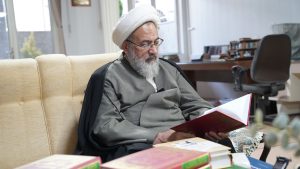
Continuing the meeting, after listening to the report on the Secretariat’s activities, Ayatollah Abolqasem Alidoost recited the noble verse, “Indeed, they were youths who believed in their Lord, and We increased them in guidance,” and described the sincere efforts of the Congress researchers as an example of divine grace in reviving the little-known heritage of sincere scholars. Praising the Secretariat’s commitment to reviving and publishing original texts, and comparing this endeavor with the successful experiences of enduring congresses devoted to figures such as Muhaqqiq Na’ini, Sheikh Ansari, Shahid al-Awwal, and Shahid al-Thani, he stated: “The credibility and lasting impact of any congress depend on the production of scholarly works and the preservation of heritage from dispersal. Fortunately, by collecting and presenting dozens of volumes of valuable works, this Congress has also laid a lasting foundation for theological studies.”
Ayatollah Alidoost then elaborated on two essential content-related priorities for further enriching these activities:
- A systematic approach to the hadith heritage: Emphasizing that Allamah’s approach to texts should be independently examined and explained, he added: “One of the shortcomings today is the absence of a systematic and hierarchical understanding of the heritage. Just as Wahid Behbahani, in confronting the Akhbaris, emphasized adherence to the textual sources while at the same time warning against stopping at their initial apparent meanings without considering the broader corpus of narrations, the Congress researchers should likewise determine how Mir Hamed Hussain analyzed evidence and texts within a comprehensive framework. This subject should be given a special place, whether in the methodology volumes or in the keynote addresses of the Congress.”
- Observing dignity and the ethics of scholarly debate: Praising Allamah Amini for the dignified tone of his writing in Al-Ghadir, he emphasized the need for the Congress’s works to reflect refined and respectful language, and said: “In contemporary rewritings and summaries, it should be kept in mind that today’s reader approaches a work free from the emotional tensions of historical disputes. Therefore, arguments should be presented in a dignified, rigorous, demonstrative manner and without a harsh tone, so that the truth of the discourse may become evident.”
The professor of advanced jurisprudence at the seminary also referred to the harm caused by an atmosphere of intolerance in some contemporary intellectual currents and identified a renewed examination of the approach of earlier scholars—particularly their scholarly criticism and breadth of mind in theological discourse—as one of the urgent needs of the seminary.
In the final part of the meeting, Hojatoleslam wal-Muslimeen Sobhani, President of the Congress, referred to the civilizational background of Shiism in Lucknow and to Allamah Mir Hamed Hussain’s and the Ghufran Ma’ab family’s mastery of jurisprudence and the principles of jurisprudence within the Najaf school of jurisprudence. He also announced the Congress’s plans to elucidate the jurisprudential dimensions of the author of Abaqat al-Anwar and to hold supplementary preliminary sessions, and expressed his appreciation for Ayatollah Alidoost’s jurisprudential and methodological guidance.