The Splendor of the Lucknow School in the Indian Travelogue of the Author of *al-Ghadir***
**Allamah Amini’s Historical Account and Praise of the Treasures of the Nasiriyya Library
Abstract
In 1961 (1380 AH), Allamah Shaykh Abd al-Husayn Amini (May Allah sanctify his soul), author of the unparalleled encyclopedia *al-Ghadir*, traveled to the Indian subcontinent on a four-month journey. The primary objective of this historic journey was to gain access to early, first-hand sources from both sides and to transcribe rare documents for the completion of the volumes of *al-Ghadir* and the enrichment of the Amir al-Mu’minin Library in Najaf. The highlight of the journey was his month-long stay in Lucknow, the warm hospitality and companionship of the Abaqat family, and the indescribable amazement of the author of *al-Ghadir* at the unparalleled holdings of the Nasiriyya Library—an event that immortalized the bond between two major centers devoted to defending the doctrine of Imamate in Najaf al-Ashraf and Lucknow.
Background and Motivation for the Journey to the Indian Subcontinent
Allamah Abd al-Husayn Amini’s (May Allah sanctify his soul) tireless investigation and exhaustive research into the documentary evidence concerning Wilayah constituted one of the most distinguished aspects of his scholarly life. Near the end of his life, despite his advanced age, he realized that a significant number of early manuscripts and rare sources from the first centuries of Islam could not be found in the libraries of Iran and Iraq. Accordingly, on February 11, 1961 (24 Sha‘ban 1380 AH), he set out for the Indian subcontinent.
The four-month journey produced, in the words of his son Shaykh Reza Amini and Professor Mohammad Reza Hakimi, an extraordinary scholarly achievement: nearly 2,500 pages of unique manuscript material were copied and transcribed solely in Allamah Amini’s own hand.
Arrival in Lucknow and the Welcome by the Descendants of Mir Hamed Hussain
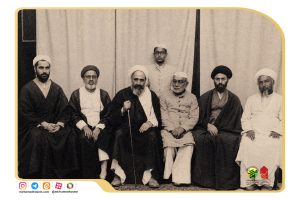
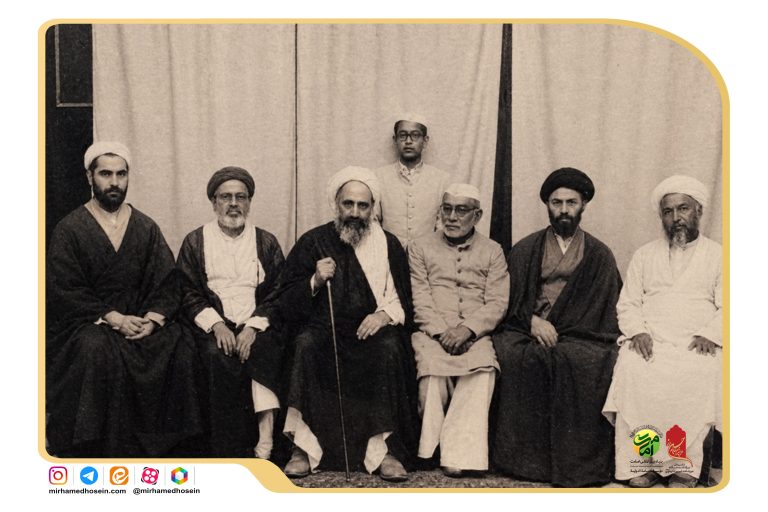
Allamah Amini’s arrival in Lucknow—the historic and scholarly center of Shi‘ism in the northern Indian subcontinent—was met with a broad welcome from scholars and learned figures. Among the most memorable aspects of this journey was his meeting and close association with the family of the author of *Abaqat*.
Shaykh Reza Amini writes in his memoirs:
*“The eminent scholar Sayyid Mohammad Sa‘id Abaqati—the son of the renowned scholar Sayyid Nasir Hussain and the grandson of Allamah Mir Hamed Hussain (May Allah sanctify his soul)—was never apart from us morning or evening. We shall never forget the virtues we witnessed in him and in his learned and highly respected brother, Sayyid Nasir al-Milla. The abundant share they had inherited from their ancestor and the ample portion they possessed of his virtues are not things that can be forgotten.”*
In the Presence of the Nasiriyya Treasure: The Author of *al-Ghadir* in Amazement
Allamah Amini was deeply affected by his visit to the Nasiriyya Library in Lucknow—a collection of 30,000 volumes, including more than 5,000 rare manuscripts, assembled through the devotion and immense efforts of three generations of standard-bearers of Wilayah: Allamah Mufti Sayyid Mohammad Quli, Allamah Mir Hamed Hussain, and Ayatollah Sayyid Nasir Hussain.
On May 10, 1961 (24 Dhu al-Qi‘dah 1380 AH), Allamah Amini wrote a historic and enduring note in the library’s memorial register, reflecting the astonishing grandeur of the Abaqat scholarly heritage:
*“The flourishing Nasiriyya Library had occupied an immensely great and exalted place in my mind ever since I became acquainted with the works of its founders—heroes of knowledge, authorities in scholarly debate, and manifest signs of the school, through works such as* Tashyid al-Mata‘in, Abaqat al-Anwar, *and* Istiqsa al-Ifham*…*
*Throughout my life, despite having seen numerous richly stocked libraries throughout the East and the Islamic world, I have never seen a library like this one—so comprehensive in its collection of precious works and rare books, and so rich in the scholarly heritage of every branch of learning and discipline.*
*By my life! Had even a portion of these works been preserved in one of the libraries of the West, the world would have been filled with publicity, pride, and celebration of them; the pages of newspapers and journals throughout the world would have been adorned with their name, and their fame would have echoed through international media. Yet, regrettably, this immense treasure has remained neglected among our inattentive community…”*
The Nasiriyya Library’s Contribution to the Later Volumes of *al-Ghadir***
During his stay in Lucknow, the author of *al-Ghadir* spent most hours of the day and night searching and transcribing materials in the Nasiriyya Library. He personally copied works that had remained beyond the reach of Shi‘i scholars in Iraq and Iran for centuries, so that they could provide definitive documentation for volume twelve and subsequent volumes of *al-Ghadir* and enrich the holdings of the Maktabat al-Imam Amir al-Mu’minin (peace be upon him) in Najaf al-Ashraf:
– ***al-Manaqib* by the Shafi‘i jurist Ibn al-Maghazili (d. 483 AH): A precious manuscript dated 1037 AH and based on a sixth-century AH copy. Despite the book having remained beyond the reach of Shi‘i scholarly centers for some nine centuries, Allamah personally transcribed the entire work.
– ***Miftah al-Naja fi Manaqib Al al-‘Aba*, by Mirza Mohammad ibn Rustam Badakhshi (composed in 1123 AH): A valuable work of 320 pages, copied in Allamah Amini’s own hand.
– ***al-Sirat al-Sawi fi Manaqib Al al-Nabi*, by Sayyid Mahmud Shaykhani Qadiri (tenth century AH): A work of 494 pages, approximately 400 pages of which were written directly in Allamah Amini’s own hand.
– ***Dhakhirat al-Ma’al fi Sharh Jawahir al-‘Iqdayn*, by Ahmad ibn Abd al-Qadir Hifzi al-Shafi‘i: A precious manuscript of 406 pages. Its author was among the poets of Ghadir in the twelfth century AH, and Allamah Amini brought the manuscript to the library in Najaf.
**A Bond between Two Peaks of Imamate Studies
Allamah Amini’s Indian travelogue constitutes firm historical evidence of the profound connection between the scholarly tradition of *Abaqat al-Anwar* in India and *al-Ghadir* in Najaf al-Ashraf. It demonstrates how Allamah Mir Hamed Hussain Lakhnawi’s efforts to establish the Nasiriyya Library and gather Sunni sources became, decades later, a major scholarly foundation for the greatest theological encyclopedia of the fourteenth century AH, *al-Ghadir*.
Today, the International Congress Commemorating Allamah Mir Hamed Hussain (May Allah sanctify his soul), in pursuing its mission to restore this authentic scholarly heritage, follows the same concern that the author of *al-Ghadir* voiced in the memorial register of the Nasiriyya Library:
To rescue the neglected heritage of Ghadir from the dust of oblivion and place it at the heart of scholarly studies in the contemporary world.
Download Box for the File and Related Documents: