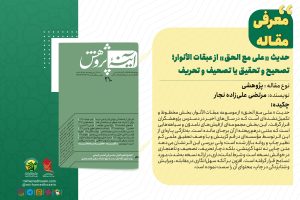
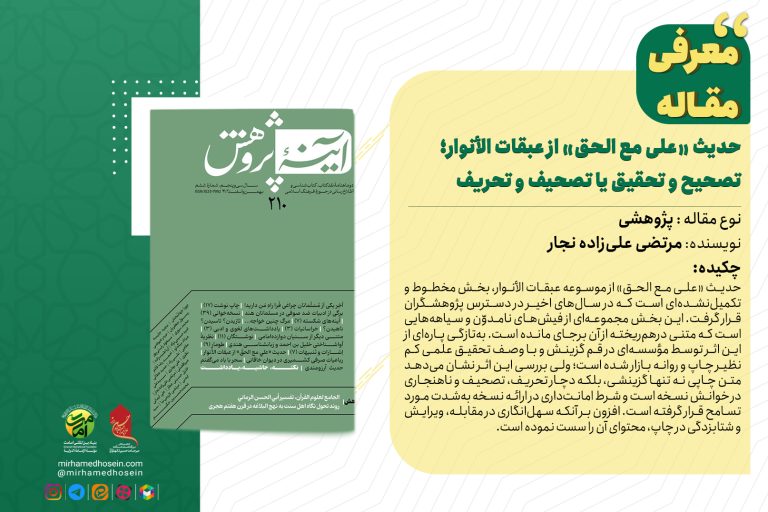
Article: A Critique and Review of the Critical Edition of “Hadith Ali ma‘a al-Haqq” from Abaqat al-Anwar: Critical Editing and Research, or Corruption and Distortion?
Publication Details: Ayeneh-ye Pazhuhesh, a scholarly-specialized bimonthly journal, Year 35, No. 6 (consecutive issue 210), January 20–March 20, 2025, pp. 283–314.
Abstract: “Hadith Ali ma‘a al-Haqq,” from the Abaqat al-Anwar encyclopedia, is an incomplete manuscript section that became available to researchers in recent years. This section consists of a collection of unorganized research slips and rough notes, most of which were written by copyists unfamiliar with the relevant vocabulary and terminology; consequently, what has survived is a disordered text containing numerous errors. Recently, a portion of these notes that possesses greater order and continuity was selected by an institute in Qom and published with grand claims of “critical editing, research, and annotation” and described as “a rarely matched scholarly investigation.” An examination of the work, however, shows that the printed text is not only selective, but also suffers from distortion, textual corruption, and serious irregularities in the reading of the manuscript, while the requirement of fidelity in presenting the manuscript has been treated with considerable laxity. Moreover, negligence in collation and editing, typographical errors, and haste in publication have damaged this distinguished work and weakened its content. A re-examination of this incomplete and error-ridden edition undermines confidence in the printed text and demonstrates the necessity of preparing a new critical edition.
Preserving and safeguarding the written heritage of earlier generations—particularly works directly connected with the theological and religious identity of Shi‘ism—is a grave and undeniable responsibility. Foremost among this heritage stands the noble work Abaqat al-Anwar fi Imamat al-A’immat al-Athar, the enduring masterpiece of the devoted scholar Allamah Mir Hamed Hussain Lakhnawi (May Allah sanctify his soul), composed as a critique and refutation of the seventh chapter of Dehlavi’s Tuhfat al-Ithna ‘Ashariyya.
Background of the “Hadith Ali ma‘a al-Haqq” Section in Abaqat
The writing of all the volumes of Abaqat al-Anwar was not completed during the author’s lifetime, and some volumes remained only in the form of handwritten materials, drafts, and the author’s notes. The section on “Hadith Ali ma‘a al-Haqq” is among these manuscript portions and remained for many years in obscurity among scattered papers and notebooks of the Nasiriyya Library in Lucknow and the photographic copies preserved at Astan Quds Razavi.
Critical editing of such notes, due to scribal spelling errors and Indian orthographic conventions, requires a precise methodology, a thorough command of the author’s system of references, and particular skill in contextual reading in order to prevent any distortion or scholarly error. Unfortunately, the hasty publication of this section by an institute resulted in the release of an incomplete work filled with textual distortions and corrupt readings.
Factors Contributing to the Corruption and Distortion of the Text in the Recent Edition
Through a comparative examination of the printed edition against the base manuscript—no. 24924 in the Astan Quds Razavi Library—and against reference sources, the author of the article has documented the principal defects of this edition under the following headings:
- Incorrect readings and intervention in the text: Words in the manuscript have been altered and turned into meaningless or fabricated expressions, thereby distorting the author’s precise criticisms and arguments. Examples include misreading “مثلهای عامیانه” (“common sayings/examples”) as “شکهای عامیانه” (“common doubts”), and changing “آن قسم که موضع است” into the fabricated expression “که موضوع است”.
- Unwarranted alteration of sigla: The abbreviation “آه” has been changed to “الخ” without scholarly justification, while the siglum “ح”, denoting a lithographed edition, has been repeatedly assigned to this work throughout the footnotes, even though this section was never published lithographically!
- Arbitrary omission of the author’s text: Fundamental passages from Allamah’s own words have been dropped and omitted without the slightest indication in the footnotes, on the pretext that the author’s discourse was incomplete.
- Additions to headings and expressions: Inaccurate headings have been inserted without any distinguishing marker—for example, headings assigned to the various arguments refuting a fabricated narration—resulting in the improper attribution of those headings to Allamah.
- Negligence and confusion in collation with the sources: Quotations have not been carefully checked against the original works, such as al-Bawariq al-Mubiqa, and Allamah’s literary prose and descriptions of the Ahl al-Bayt (peace be upon them) have been distorted.
Conclusion and the Need for a New Critical Edition
As stated in the conclusion of the article, the existing printed edition, because of its selective character, omission of substantial portions, extensive textual corruptions, and lack of fidelity to the manuscript, has undermined scholarly confidence in the text and compromised the standing of the distinguished encyclopedia Abaqat al-Anwar.
Accordingly, the preparation of a scholarly, methodical, comprehensive, and critically refined edition by researchers and specialists engaged in reviving the scholarly heritage of Lucknow is an urgent and undeniable necessity.
Researcher’s Introduction to the Revival of Hadith al-Wilayah in ʿAbaqāt al-Anwār