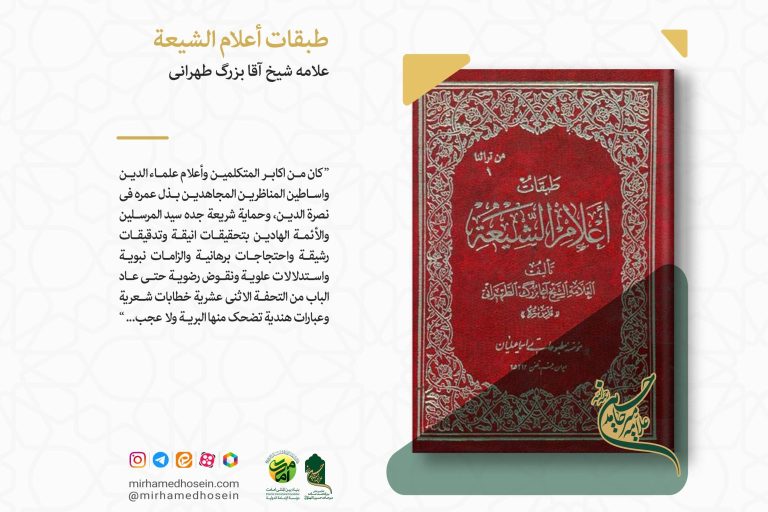
Allamah Mir Hamid Husayn in *Tabaqat A’lam al-Shia

چکیده: He is al-Sayyid al-Amir Hamid Husayn ibn al-Amir Sayyid Muhammad ‘Ali (Muhammad Quli) ibn al-Sayyid Muhammad ibn Hamid Husayn al-Musawi al-Nishapuri al-Kunturi al-Hindi al-Lakhnawi. He is among the greatest Imami theologians and the most profound Shia scholars of the early 14th century. Born in Lucknow (1830), he grew up under his father’s guidance, mastering preliminary sciences. He studied *Kalam* (theology) under his father, Imam Sayyid Muhammad Quli, and *Fiqh* and *Usul* under "Sayyid al-‘Ulama’" Sayyid Husayn al-Naqawi.

Allamah Mir Hamid Husayn in *Tabaqat A’lam al-Shia

Scholarly Stature:

He was characterized by immense research and comprehensive knowledge of Islamic heritage, hadith, and tradition, reaching a level of depth unmatched by his contemporaries, successors, and even many predecessors. He dedicated his life to uncovering the secrets of faith and defending the religion. History has rarely seen his equal in research, precision, intelligence, and memory.

The Library:

He possessed a singular library in India—a pride of the Shia world—containing 30,000 printed and manuscript volumes, especially rare Sunni texts. Our teacher, Mirza Husayn al-Nuri, narrated: “I expressed surprise to him that such a great library would lack a specific book I had. He replied, ‘I am certain there are several copies in my library, but finding one takes time. The book you send will reach me before I can locate the one currently in my library.'”

Works:

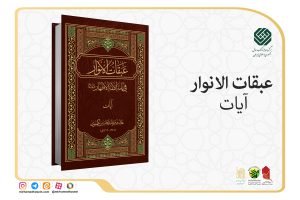
His masterpiece is *Abqāt al-Anwār fī Manāqib al-A’immah al-Aṭhār*, the greatest work on the Imamate since the dawn of Islam, spanning over ten large volumes. Other major works include *Istiqṣā’ al-Ifhām* (a 10-volume refutation of *Muntahā al-Kalām*), *al-Sharī‘at al-Gharrā’* (Jurisprudence), and many others.

Allamah Mir Hamid Husayn in “Masfā al-Maqāl”

Leave a Comment

Your email address will not be published. Required fields are marked *

Manuscript Repository

Researcher’s Introduction to the Revival of Hadith al-Wilayah in ʿAbaqāt al-Anwār

 Hadith al-Wilayah is the third hadith that ʿAbd al-ʿAzīz al-Dihlawī addressed in Chapter Seven of the book Tuḥfah-yi Ithnā ʿAshariyyah. Since this hadith is one of the explicit texts proving the immediate succession and Imamate of Amīr al-Muʾminīn (peace be upon him), he found no alternative but to deny and invalidate it.

Research Resources

A Brief Survey of the Ḥadīth of Ghadīr in ʿAbaqāt al‑Anwār

Despite the many discussions surrounding the Ḥadīth of Ghadīr throughout history, before the writing of ʿAbaqāt al‑Anwār one cannot find a work that has addressed all aspects of this ḥadīth in detail and responded to the various objections of the Sunnīs regarding its chain (isnād) and implication (dalāla). Indeed, the efforts of ʿAllāma Mīr Ḥāmid Ḥusayn al‑Hindī were not limited to responding to the objections of ʿAbd al‑ʿAzīz al‑Dehlawī; rather, by tracing the roots of the doubts, he used Dehlawī’s statements as a basis for presenting and critiquing the statements of earlier Sunnī scholars, leaving behind a comprehensive and solid work. May Allah have mercy upon him and grant him a good abode.

Notes

Re-examining the “Manhaj of the Verses” in ʿAbaqāt al-Anwār

Among the different sections of ʿAbaqāt al-Anwār, its “First Manhaj” holds a fundamental position in explaining the question of Imamate. This section, commonly known by the title “Verses,” may at first appear to be devoted solely to examining the verses that indicate Imamate; however, a more careful study of the structure of ʿAbaqāt shows that this understanding is incomplete and, to some extent, incorrect.

Scroll to Top