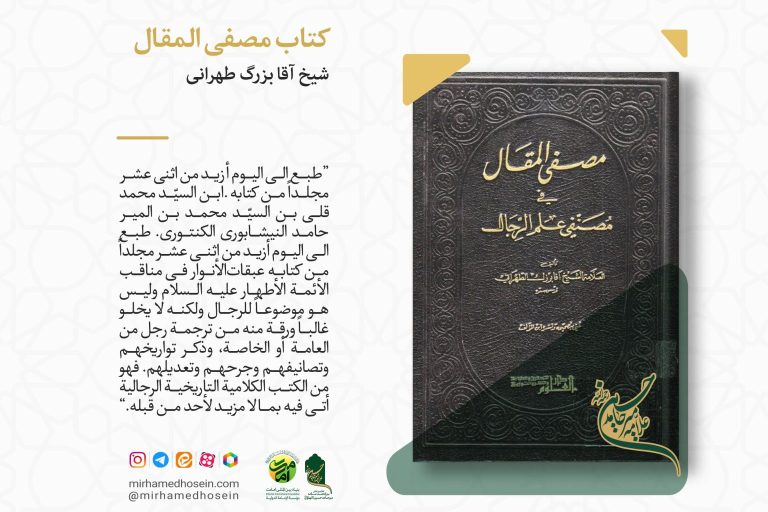
Allamah Mir Hamid Husayn in “Masfā al-Maqāl”

چکیده: He is al-Sayyid al-Mir Hamid Husayn, son of al-Sayyid Muhammad Quli, son of al-Sayyid Muhammad, son of al-Mir Hamid al-Nishapuri al-Kunturi. To this day, more than twelve volumes of his book, «عبقات الانوار فی مناقب ائمه الاطهار», have been published. Although the book is not specifically a subject of Ilm al-Rijal (the science of biographical evaluation), most of its pages contain biographies of individuals, whether common or elite, mentioning their dates, their works, and their *Jarh wa Ta'dil* (evaluation of reliability). Thus, it is one of those theological, historical, and biographical (Rijali) books that has achieved unparalleled depth.

Allamah Mir Hamid Husayn in “Masfā al-Maqāl”

## About the book “Masfā al-Maqāl”

“Masfā al-Maqāl fī Musannifī ‘Ilm al-Rijāl” is an Arabic work written by Agha Bozorg Tehrani (d. 1970). In this work, the author introduces the authors of Shia biographical (Rijali) books, providing a brief account of their lives and their scholarly works. The book includes biographies of 660 scholars of Ilm al-Rijal.

“Masfā al-Maqāl” is a detailed treatise on the biographies of the authors of Shia biographical books and their works. It lists figures from the era of the Minor Occultation up to the author’s time in alphabetical order, mentioning their books beneath their names. The author spent from 1900 to 1950 collecting and composing this work.

Leave a Comment

Your email address will not be published. Required fields are marked *

Research Resources

A Brief Survey of the Ḥadīth of Ghadīr in ʿAbaqāt al‑Anwār

Despite the many discussions surrounding the Ḥadīth of Ghadīr throughout history, before the writing of ʿAbaqāt al‑Anwār one cannot find a work that has addressed all aspects of this ḥadīth in detail and responded to the various objections of the Sunnīs regarding its chain (isnād) and implication (dalāla). Indeed, the efforts of ʿAllāma Mīr Ḥāmid Ḥusayn al‑Hindī were not limited to responding to the objections of ʿAbd al‑ʿAzīz al‑Dehlawī; rather, by tracing the roots of the doubts, he used Dehlawī’s statements as a basis for presenting and critiquing the statements of earlier Sunnī scholars, leaving behind a comprehensive and solid work. May Allah have mercy upon him and grant him a good abode.

Notes

Re-examining the “Manhaj of the Verses” in ʿAbaqāt al-Anwār

Among the different sections of ʿAbaqāt al-Anwār, its “First Manhaj” holds a fundamental position in explaining the question of Imamate. This section, commonly known by the title “Verses,” may at first appear to be devoted solely to examining the verses that indicate Imamate; however, a more careful study of the structure of ʿAbaqāt shows that this understanding is incomplete and, to some extent, incorrect.

Notes

Re-examining “Hadith al-Ghadir” in ʿAbaqāt al-Anwār

Among the textual proofs related to the question of Imamate, Hadith al-Ghadir holds a special position. This hadith, which has been transmitted with the well-known wording, “Whoever I am his mawla, then this ʿAlī is his mawla,” is among the traditions that have received extensive attention from Muslim scholars throughout history. However, a comprehensive and methodical examination of this hadith requires extensive investigation across various sources and a precise analysis of both its chain of transmission and its indication.

Notes

Re-examining “Hadith al-Wilayah” in ʿAbaqāt al-Anwār

The examination of “Hadith al-Wilayah” in ʿAbaqāt al-Anwār is a clear example of Allamah Mīr Ḥāmid Ḥusayn’s scholarly methodology; a methodology in which extensive investigation, precise analysis of chains of transmission, and multilayered analysis of indication are brought together.

Scroll to Top