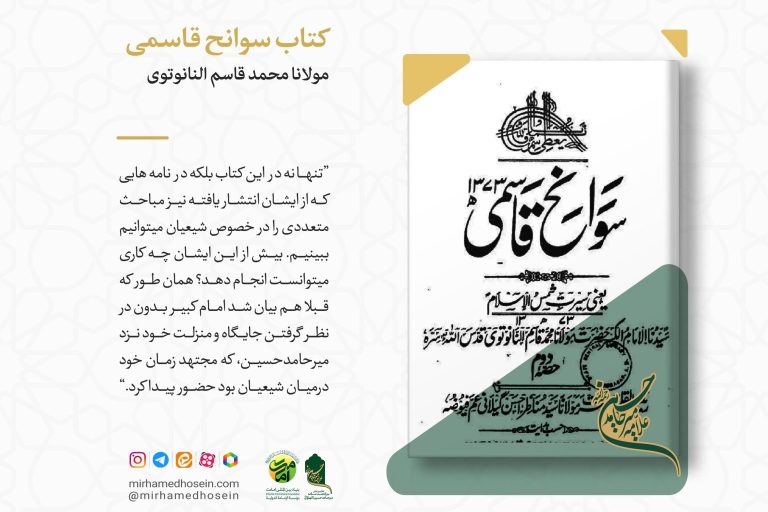
Allamah Mir Hamid Hussain in “Sawanih Qasimi”

چکیده: Not only in this book, but also in the letters that have been published from him, we can see numerous discussions regarding the Shia. What more could he have done? As mentioned earlier, the "Imam al-Kabir" (Great Imam) visited Mir Hamid Hussain—who was the *mujtahid* of his time among the Shia—without considering his own status and rank.

Allamah Mir Hamid Hussain in “Sawanih Qasimi”

**In the Name of God, the Most Gracious, the Most Merciful**

**Allamah Mir Hamid Hussain in “Sawanih Qasimi”**

**A reference to the meeting between Mawlavi Muhammad Qasim, a Sunni scholar, and the late Allamah**

[This text is a translation of the book]

Not only in this book, but also in the letters that have been published from him, we can see numerous discussions regarding the Shia. What more could he have done? As mentioned earlier, the “Imam al-Kabir” visited Mir Hamid Hussain—who was the *mujtahid* of his time among the Shia—without considering his own status and rank. As he himself mentioned in a letter to Mawlavi Zia al-Din Rampuri, he described the nature of this meeting with these words: “I went, without a turban or a shawl—as is the custom—to the place where Mawlavi Hamid Hussain Sahib Lakhnawi, the Shia… was staying.”

Debates and conversations took place between the two sides during this meeting, and Mawlavi Hamid Hussain did not realize that the person he was speaking with was Mawlana Muhammad Qasim.

And God knows best. However, it is not known exactly where this meeting took place. It seems unlikely that this meeting occurred in Lucknow. However, the evidence suggests that he met Mawlavi Hamid Hussain in Meerut or Saharanpur, or that Mawlavi Hamid Hussain had come to Delhi for some business, and “Wala Hazrat” (His Excellency) went to visit him.

Debates and conversations took place between the two sides during this meeting, and Mawlavi Hamid Hussain did not realize that the person he was speaking with was Mawlana Muhammad Qasim; because instead of using his famous name, he had mentioned his historical name, which is “Khursheed Hassan.” Just as Shah Abdul Aziz also introduced himself in “Tuhfa Ithna Ashari” as “Ghulam Halim,” which is his historical name. In any case, following the tradition of the great ones must be considered a blessing, and that was achieved for him.

**Keywords:**

Allamah Mir Hamid Hussain – Memoirs – Debate – Scientific Status

Allamah Mir Hamid Hussain in the Book “Mir’at al-Kutub”

Leave a Comment

Your email address will not be published. Required fields are marked *

Manuscript Repository

Researcher’s Introduction to the Revival of Hadith al-Wilayah in ʿAbaqāt al-Anwār

 Hadith al-Wilayah is the third hadith that ʿAbd al-ʿAzīz al-Dihlawī addressed in Chapter Seven of the book Tuḥfah-yi Ithnā ʿAshariyyah. Since this hadith is one of the explicit texts proving the immediate succession and Imamate of Amīr al-Muʾminīn (peace be upon him), he found no alternative but to deny and invalidate it.

Research Resources

A Brief Survey of the Ḥadīth of Ghadīr in ʿAbaqāt al‑Anwār

Despite the many discussions surrounding the Ḥadīth of Ghadīr throughout history, before the writing of ʿAbaqāt al‑Anwār one cannot find a work that has addressed all aspects of this ḥadīth in detail and responded to the various objections of the Sunnīs regarding its chain (isnād) and implication (dalāla). Indeed, the efforts of ʿAllāma Mīr Ḥāmid Ḥusayn al‑Hindī were not limited to responding to the objections of ʿAbd al‑ʿAzīz al‑Dehlawī; rather, by tracing the roots of the doubts, he used Dehlawī’s statements as a basis for presenting and critiquing the statements of earlier Sunnī scholars, leaving behind a comprehensive and solid work. May Allah have mercy upon him and grant him a good abode.

Notes

Re-examining the “Manhaj of the Verses” in ʿAbaqāt al-Anwār

Among the different sections of ʿAbaqāt al-Anwār, its “First Manhaj” holds a fundamental position in explaining the question of Imamate. This section, commonly known by the title “Verses,” may at first appear to be devoted solely to examining the verses that indicate Imamate; however, a more careful study of the structure of ʿAbaqāt shows that this understanding is incomplete and, to some extent, incorrect.

Scroll to Top