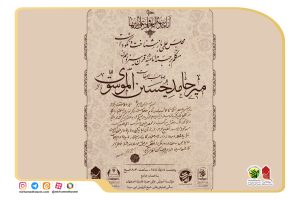
Allamah Mir Hamid Hussain in the Book “Mir’at al-Kutub”
**Bibliography**
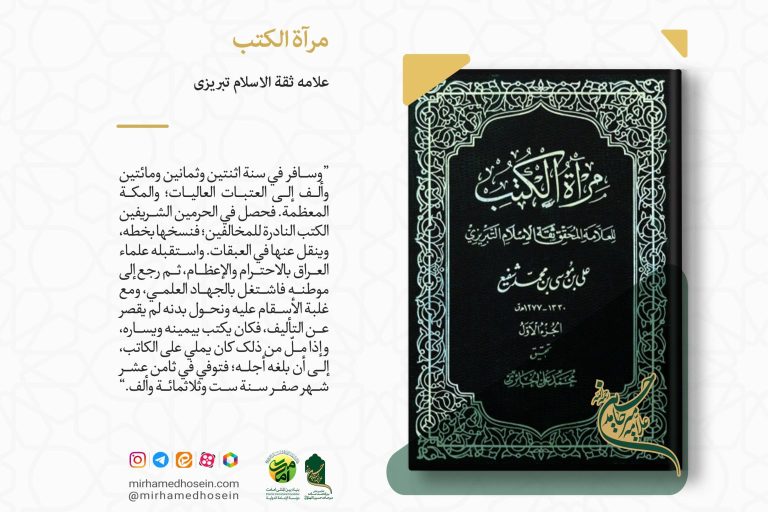
“Mir’at al-Kutub,” by Ali bin Musa bin Muhammad Shafi, known as Thiqat al-Islam Tabrizi, with the research of Muhammad Ali Ha’iri, consists of the biographies of Imami scholars and their works, spanning from the era of Shaykh al-Tusi to the author’s time. The book is written in Arabic and was composed in the early fourteenth century Hijri Qamari. The reason for writing the book is the vacuum the author felt in the works of his predecessors and the lack of their organization based on the science of bibliography. The present book is one of the useful historical Arabic works compiled on the bibliography of Shia books.
**Keywords:** Specifications – Biography – Birth – Place of Residence – Death – Scientific Life – Works
*(Main text follows as previously provided…)*
**Footnotes (Translated):**
[1] Sayyid al-Amir Hamid Hussain ibn al-Amir al-Mufti Sayyid Muhammad Quli ibn Muhammad Hussain ibn Hamid Hussain ibn Zain al-Abidin al-Musawi al-Nisaburi al-Kinturi al-Lucknawi al-Hindi, passed away in 1306 Hijri Qamari. The author of “A’yan al-Shia” praised him, saying: “He was one of the greatest theologians who researched the secrets of religion, and a defender of the sanctuary of Sharia and the domain of the true religion. A profound Allamah, skilled in the art of theology and debate, knowledgeable in narrations and historical reports, widely informed and constantly studying. No one like him was seen in the art of theology and mastery over reports and history in his time; or even long before and after his time until today. If we say that no one like him has appeared among the Imami scholars since the era of al-Mufid and al-Murtaza, we are not exaggerating… His fame spread in the East and the West, and the great scholars acknowledged his virtue. He was a master of many sciences: theologian, narrator, biographer, and literary scholar. He spent his life in teaching, writing, and researching. His library in Lucknow is unique in the number and variety of books, especially non-Shia works.” (See listed references in the original text).
[2] His famous library is now known as “al-Maktabah al-Nasiriyyah,” and it is one of the most important Islamic libraries containing precious manuscripts. It is stated in the journal of the library issued by the library of Imam Ali (pbuh) in Najaf, vol. 1, p. 14: “This grand library flourishes among scientific circles and cultural centers in the Islamic world for its numerous rarities and precious antiquities, and the many books it contains in high sciences, including jurisprudence, principles, interpretation, hadith, theology, wisdom, philosophy, ethics, history, language, and literature; in addition to dictionaries, collections, and encyclopedias in geography, biography, and biographical evaluation…”
[3] Shams al-Ulama Sayyid Nasir Hussain ibn Sayyid Hamid Hussain al-Musawi al-Lucknawi, passed away in 1361. Allamah al-Amin wrote his biography, saying: “An Imam in biography and hadith, deeply researched, widely informed, and strong-memoried. Hardly anyone asked him for a matter without him directing them to its source in books, while pointing out the page numbers. He was one of the pillars and authorities in India, commanding reverence and awe in the hearts of the common people.”
[4] No part of “Nujum al-Sama fi Tarajim al-Ulama” was published except for what was printed in one volume in 1303 in Lucknow during the life of its author, Mawlavi Mirza Muhammad Ali ibn Sadiq Ali al-Kashmiri, who passed away in 1309. This volume includes the biographies of scholars from the eleventh century to the middle of the thirteenth century Hijri.
[5] As in the original.
[6] “Hamlah-ye Haydari” is about the life of the Prophet and the Successor (pbuh) and his battles until his martyrdom. It was composed in Persian by Mirza Muhammad Rafi ibn Muhammad al-Mashhadi, known as “Bazil,” who passed away in 1123 or 1124.
[7] Sayyid Barkat Ali al-Lahori, passed away after 1270.
[8] He is Mawlana Sayyid Murtaza, titled “Khulasat al-Ulama,” son of Sultan al-Ulama Sayyid Muhammad, son of Mawlana Sayyid Dildar Ali al-Nasirabadi, passed away in 1276.
[9] Sayyid Muhammad ibn Sayyid Dildar Ali al-Naqvi al-Nasirabadi al-Lucknawi, famous as Sultan al-Ulama, passed away in 1284. It is stated in “al-A’yan”: “He was a jurist, philosopher, and theologian, articulate in speech and excellent in writing. He studied under his father, and the leadership of the Jafari school was transferred to him. Judgment and judiciary were entrusted to him during the reign of Sultan Abu al-Muzaffar Muslih al-Din Amjad Ali Shah, and he compelled the judges of the country to apply their rulings according to his fatwas…”
[10] Mawlana Sayyid Hussain ibn Sayyid Dildar Ali al-Nasirabadi, famous as Sayyid al-Ulama, passed away in 1273. He was one of the greatest scholars of his time, knowledgeable in interpretation, hadith, jurisprudence, principles, and theology.
[11] “al-Futuhat al-Haydariyyah” in refutation of the book “al-Sirat al-Mustaqim” by Abd al-Hayy al-Dehlavi.
[12] “Tashyid al-Mata’in” in refutation of the tenth chapter of “al-Tuhfah al-Ithna Ashariyyah,” printed in Lucknow in lithograph.
[13] “Muntaha al-Kalam” by Sheikh Haidar Ali ibn Muhammad Hassan al-Dehlavi, then al-Faizabadi, passed away in 1299.
[14] Sayyid Ahmad Ali ibn Inayat Haidar al-Husaini al-Muhammadabadi, passed away in 1295, one of the students of Sayyid Dildar Ali.
[15] The original manuscript is in his grand library in Lucknow, and a copy of it is in the General Library of Ayatollah Mar’ashi in Qom.