
The Researcher’s Introduction to the Revival of the Qur’anic Verses Section of Abaqat al-Anwar
Abaqat al-Anwar fi Imamat al-A’immat al-Athar (peace be upon them) is the most extensive work devoted to the subject of Imamate. Written as a critique of the seventh chapter of Abd al-Aziz Dehlavi’s Tuhfat al-Ithna ‘Ashariyya, the book consists of two manhajs.
The Second Manhaj is devoted to establishing the validity of the Imamiyya’s argument based on twelve hadiths whose indication of the Imamate of Amir al-Mu’minin (peace be upon him) Dehlavi regarded as incomplete. Significant portions of this section were published during the lifetime of Allamah Mir Hamed Hussain and, after him, by his son, the late Nasir Hussain.
The First Manhaj of Abaqat al-Anwar, however, was not published during the lifetime of either the author or his son, and regrettably its profound contents remained neglected for many years among its draft and fair-copy manuscripts.[1]
The present volume is a researched and critically edited edition of this monumental work. In preparing this edition, every effort has been made, as far as possible, to exercise the degree of precision, patience, and diligence befitting the critical editing and study of an exceptional work such as Abaqat al-Anwar, and to honor the efforts of the devoted scholar Allamah Mir Hamed Hussain Lakhnawi in compiling this book by presenting a sound and critically established text.
Accordingly, an effort has been made to produce a final text so thoroughly refined, corrected, and critically examined that the reader of Abaqat al-Anwar will perceive no difference in editorial quality between its First Manhaj, whose two extant copies are manuscripts,[2] and its Second Manhaj, whose surviving copies are printed and well preserved.
Correcting a Misconception
It is commonly stated among researchers that the First Manhaj is likewise devoted to establishing the indication of the seven Qur’anic verses whose evidentiary force was denied by Dehlavi. This notion appears for the first time in Diya al-Ayn, written by Iftikhar al-Ulama, one of the students of Allamah Mir Hamed Hussain.[3]
On the basis of a report he cites from the catalogue of the Nasiriyya Library, he regarded the First Manhaj of Abaqat al-Anwar as being confined to the section on Qur’anic verses:
“It would not be out of place here, in the biographical account of the author of Abaqat, to explain the First and Second Manhajs of Abaqat as well; for biographers of this eminent scholar and compilers of book catalogues have fallen into confusion and inconsistency in understanding this matter. Likewise, what has been written in the catalogue of the books of the Holy Razavi Shrine under Abaqat concerning the two manhajs is not correct!
Regarding this matter, I shall reproduce selected passages from the catalogue of the author’s library so that the details of the volumes of Abaqat and the explanation of the two manhajs may become clear, and so that it may also become known how many volumes have not yet emerged into the stage of composition and authorship.
‘Abaqat al-Anwar: This precious work contains the response to the seventh chapter of al-Tuhfa, which is the chapter on Imamate. The response itself is arranged according to two manhajs. The first of them concerns the Qur’anic verses, which are seven verses: (((إِنَّمَا وَلِيُّكُمُ اللَّهُ…)))، (((إِنَّما يُريدُ اللَّهُ…)))…’”[4]
It is possible that this very report contributed to the entrenchment of this view in the mind of the great authority in the field of biography and bibliography, the late Aqa Buzurg Tehrani. In his entry on Abaqat, he states:
“هو ردٌّ على الباب السابع من التحفة الاثني عشريّة، الّذي هو في مباحث الإمامة. و رتّبه على منهجين: المنهج الأوّل في إثبات دلالة الآيات القرآنيّة المستدلّ بها للإمامة.”
“It is a refutation of the seventh chapter of al-Tuhfat al-Ithna ‘Ashariyya, which deals with discussions of Imamate. He arranged it according to two manhajs: the First Manhaj concerns establishing the indication of the Qur’anic verses cited as evidence for Imamate.”[5]
The effects of this assumption subsequently found their way into a large number of writings on Abaqat al-Anwar composed after al-Dhari‘a.[6]
Moreover, some writers, in addition to holding this view, maintain that Dehlavi himself divided the seventh chapter of al-Tuhfa into two manhajs—one concerning Qur’anic verses and the other concerning hadiths—and that this division was the basis for the corresponding division of Abaqat al-Anwar into its two manhajs.[7]
Neither of these two assumptions, however—the restriction of the First Manhaj of Abaqat al-Anwar to Qur’anic verses, and the claim that Allamah Mir Hamed Hussain followed Dehlavi in dividing Abaqat al-Anwar into two manhajs—is correct.
It is clear that the late author of al-Dhari‘a and the other researchers are excused in this regard, since the First Manhaj of Abaqat al-Anwar and its manuscripts were not available to them. This very fact absolves them of any criticism or reproach. May Allah, the Exalted, be pleased with them all.
The correct view is that the First Manhaj is not confined to the section on Qur’anic verses. Allamah Mir Hamed Hussain Lakhnawi authored Abaqat al-Anwar fi Imamat al-A’immat al-Athar (peace be upon them) in two manhajs:
First Manhaj: This manhaj may itself be divided into two halves. The first half is devoted to responding to the six Sunni doctrines concerning Imamate and to critiquing the arguments advanced for establishing the caliphate of the caliphs.[8] The second half addresses Dehlavi’s objections to the completeness of the evidentiary force of the Qur’anic verses indicating the Imamate of Amir al-Mu’minin (peace be upon him).
Second Manhaj: This manhaj is devoted to establishing the evidentiary force of the twelve hadiths whose indication of the Imamate of Amir al-Mu’minin (peace be upon him) Dehlavi regarded as incomplete.
To establish this important point, it is first necessary to provide an account of the contents of the seventh chapter of Tuhfat al-Ithna ‘Ashariyya. In the course of this account, it will become clear that Dehlavi did not, in fact, divide the seventh chapter of al-Tuhfa into two manhajs. Consequently, it will also be established that the claim that Allamah Mir Hamed Hussain Lakhnawi followed Dehlavi in this division has no valid basis.
Likewise, in order to establish that the First Manhaj is not confined to the section on Qur’anic verses, it is necessary to provide an account of the extant manuscripts of the First Manhaj and then, by presenting firm evidence, to dispel the misconception that the First Manhaj is limited to the section on verses.
An Account of the Contents of the Seventh Chapter of Tuhfat al-Ithna ‘Ashariyya
The contents of the seventh chapter of al-Tuhfa may be divided into two sections:
Section One: This section contains Sunni beliefs concerning Imamate. In the course of this discussion, Dehlavi also refers to the beliefs of the Imamiyya and proceeds to criticize them. Approximately forty percent of the discussions in the seventh chapter are devoted to this section.
In the edition used in the present study,[9] this section begins on page 362 and continues through page 408.
In this section, Dehlavi first explains six Sunni doctrines concerning Imamate. The themes addressed under these six doctrines are: “the selection of the Imam by choice,” “the impossibility of the Imam’s concealment,” “the non-infallibility of the Imam,” “the lack of necessity for the Imam to be explicitly designated,” “the lack of a requirement that the Imam be the most virtuous,” and “the identification of the immediate successor to the Prophet (peace and blessings be upon him and his family).”
Within the sixth doctrine, Dehlavi presents arguments for the caliphate of the caliphs. In this context, he refers to three Qur’anic verses and four hadiths and, in his own view, thereby establishes their caliphate. He then cites nine arguments which, according to him, establish the caliphate of the caliphs when combined with and constructed upon a number of preliminary premises.
Section Two: In this section, under the heading “Introduction to the Discussion and Exposition of the Shi‘i Position,” Dehlavi explains and rejects the Imamiyya position on Imamate and critiques their arguments. In doing so, he refers to seven Qur’anic verses, twelve hadiths, and six rational arguments cited by the Shi‘a, and seeks, in his own view, to establish the inadequacy of each of them. At the end, under the heading “Supplement to the Discussion of Imamate,” he addresses the differences among the Shi‘i sects concerning Imamate.
This section likewise comprises approximately sixty percent of the seventh chapter. Each of the categories “Qur’anic verses,” “hadiths,” and “rational arguments together with the supplement” accounts for approximately twenty percent of the chapter.
This section begins on page 408 and continues through page 486 of the edition used in the present study.
As is clear from the overall structure of the seventh chapter, this chapter was in no way divided into a First and a Second Manhaj. Nor is there anywhere in the chapter any reference to such a division into two manhajs.
An Account of the Contents of the Extant Manuscripts[10]
Three manuscripts of the Qur’anic-verses section of the First Manhaj of Abaqat al-Anwar fi Imamat al-A’immat al-Athar (peace be upon them) are available: one draft manuscript and two fair-copy manuscripts. The most complete of the extant manuscripts is the draft manuscript itself.
The contents of this manuscript may be divided into two halves:
First Half: In this section, Allamah first critiques the first section of the seventh chapter of al-Tuhfa, mentioned above; that is, he critiques the six Sunni doctrines concerning Imamate that Dehlavi sets forth at the beginning of the seventh chapter of al-Tuhfa, within which Dehlavi also rejects Shi‘i beliefs. Allamah also critiques the arguments Dehlavi advances for the caliphate of the caliphs.
This section begins on page 1 of the manuscript and continues through page 164.
Second Half: This section contains a critique of Dehlavi’s statements rejecting the Shi‘i position on Imamate, as well as a critique of his statements rejecting the Qur’anic verses cited by the Shi‘a as evidence for the Imamate of Amir al-Mu’minin (peace be upon him).
This section begins on page 165 and continues to the end of the manuscript, page 325.
Accordingly, Allamah’s discussions in this manuscript correspond to the first section and the first third of the second section of the seventh chapter of al-Tuhfa.
Establishing That the First Manhaj Is Not Confined to the Section on Qur’anic Verses
Despite the foregoing points, since the text of the draft manuscript contains no explicit statement identifying both of its halves as the First Manhaj, it has not yet been established that both sections contained in the draft manuscript together constitute the First Manhaj of Abaqat al-Anwar.
In other words, someone might argue, in defense of the author of al-Dhari‘a and dozens of other researchers who have regarded the First Manhaj as being confined to the section on Qur’anic verses, that the First Manhaj consists only of the second part, while the section devoted to critiquing the six doctrines is a separate work independent of Abaqat al-Anwar. On this basis, the claim that the First Manhaj is limited to the section on Qur’anic verses—a view consistent with the accounts of many researchers—would remain intact.
The strongest evidence[11] that may be presented to eliminate this possibility consists of references found in the Second Manhaj of Abaqat al-Anwar—the section on hadiths. These references demonstrate that, according to Allamah’s own explicit statements, the First Manhaj is not confined to the section on Qur’anic verses; rather, it includes both sections preserved in the draft manuscript. The evidence is as follows:
- A) Instances in the hadith volumes of Abaqat al-Anwar in which the expression “First Manhaj” is used with reference to the first half of the draft manuscript:
First: “Although the discussion concerning the necessity that the caliph be the most virtuous, and the impermissibility of the caliphate of one less virtuous when one more virtuous is present, has already been treated fully and extensively in the First Manhaj, its details will also be presented later, God willing…”[12]
The passage referred to is found in the first half of the draft manuscript, on pages 46–77.
Second: “In short, Shah Wali Allah, in Izalat al-Khafa ‘an Khilafat al-Khulafa’, drawing upon Qur’anic verses, hadiths, the statements of the Companions, and the forcefulness of his own exposition and argumentation, vigorously seeks to establish that superior merit entails supreme leadership. Some of his eloquent statements have been quoted in the First Manhaj and elsewhere.”[13]
The passage referred to is found in the first half of the draft manuscript, on pages 46–77.
Third: “And since, by the praise of Allah, you have learned in the First Manhaj and elsewhere, through firm and compelling proofs and solid and decisive demonstrations, that it is impermissible to appoint the less virtuous when the more virtuous is present, there can be no doubt as to the invalidity of the Qadi’s statement.”[14]
The passage referred to is found in the first half of the draft manuscript, on pages 46–77.
Fourth: “For you previously learned, by the praise of Allah, in the First Manhaj that the attainment of universal leadership by Talut is not a matter unanimously accepted by the Sunnis.”[15]
The passage referred to is found in the first half of the draft manuscript, on page 20.
Instances in the hadith volumes of Abaqat al-Anwar in which the expression “First Manhaj” is used with reference to the second half of the draft manuscript—the section on Qur’anic verses:
First: “The reliability and religiosity, righteousness and trustworthiness, eminence and nobility, loftiness of station and exalted rank, greatness and leadership, uniqueness, mastery, and scholarly authority of al-Tha‘labi have been explained in detail in the ‘First Manhaj,’ in response to the addressee’s objections concerning the verse (((إِنَّما وَلِيُّكُمُ اللَّهُ))).”[16]
The passage referred to is found on page ??? of this book.
Second: “As for the claim that the argument of the People of Truth concerning the revelation of the noble verse regarding Amir al-Mu’minin (peace be upon him) is invalid, and the claim that the account of its revelation is false, these are among the strangest of claims and most extraordinary of assertions. For, by the praise of Allah, the Bestower, it has been established in the First Manhaj that eminent authorities, leading hadith scholars, and great Sunni exegetes have transmitted in their religious works both the revelation of this noble verse concerning Amir al-Mu’minin (peace be upon him) and the account of his giving his ring while in the state of bowing.”[17]
The passage referred to is found on page ??? of this book.
Third: “As for the feeble discussion initiated by al-Taftazani concerning the Verse of Mubahala, the Verse of Mawadda, and the Verse of Salih al-Mu’minin, the full extent of its weakness and unsoundness will not be hidden from anyone who has examined the volumes of the First Manhaj.”[18]
The passage referred to is found on page ??? of this book.
Fourth: “The fourteenth point is that Hadith al-Thaqalayn bears witness to the meaning of the fully guiding verse (((وَقِفُوهُمْ إِنَّهُمْ مَسْؤُلُونَ))). By the praise of Allah, you have already learned in the First Manhaj, in response to the addressee’s argument, with complete clarity and explicitness, that this fully guiding verse is evidence for the Imamate of Amir al-Mu’minin (peace be upon him). Therefore, Hadith al-Thaqalayn is, without doubt, evidence for his Imamate.”[19]
The passage referred to is found on page ??? of this book.
Taking these indications and pieces of evidence into account, it becomes established that the First Manhaj encompasses the entire contents of the draft manuscript. Accordingly, Abaqat al-Anwar consists of two manhajs, and its First Manhaj comprises two sections, only one of which—the second section—is devoted to Qur’anic verses.
Introduction to the Manuscripts
As noted earlier, three manuscripts of the First Manhaj of Abaqat al-Anwar fi Imamat al-A’immat al-Athar (peace be upon them) are available: one draft manuscript and two fair-copy manuscripts.
One of the two fair-copy manuscripts is a clean copy of part of the first half of the draft manuscript. In the present study, we shall refer to this manuscript as the Bayad. The other fair-copy manuscript is a clean copy of the entirety of the second half of the draft manuscript.[20] We shall refer to this manuscript as the Mubayyada.
- A) The Draft Manuscript: This manuscript is written in the hand of Allamah Mir Hamed Hussain Lakhnawi (May Allah sanctify his soul), and a reproduction of it is preserved under number 24440 at the Astan Quds Razavi Documentation Center. Some of the characteristics of this manuscript are as follows:
- The opening page of this manuscript begins with the phrase: “I say, and in Him we seek assistance: establishing the permissibility of the Imam’s concealment due to fear…” The content of this page relates to Allamah Mir Hamed Hussain Lakhnawi’s response to the second of the six doctrines that Dehlavi lists at the beginning of the seventh chapter of al-Tuhfa as Sunni beliefs concerning Imamate.
- Allamah’s seal can be seen at the top of the opening page of this manuscript.
- The final page of this manuscript ends with the phrase: “and it is found in Riyad al-Nadra.” The content of this page concerns “the precedence of Amir al-Mu’minin (peace be upon him) in embracing Islam, according to reliable Sunni hadith scholars,” a point cited in establishing the indication of the noble verse (((وَالسَّابِقُونَ السَّابِقُونَ أُوْلَئِكَ الْمُقَرَّبُونَ))) for the Imamate of Amir al-Mu’minin (peace be upon him).
- The page numbers are written at the top of the pages. They begin with page 1 and continue through page 325.
- It should be noted that, in a small number of places, the order of this manuscript has become disrupted, and the page numbers have consequently been displaced.
- A large number of pages contain handwritten marginal notes by Allamah. In some cases, these marginalia are extremely difficult to read. Some of them are marked with the sign “sahh” or with an “abru” mark and were subsequently incorporated into the text of the fair-copy manuscript. Other marginal notes, however, were not reflected in the fair copy because they related to the research process itself; an example is the marginal note on page 183 of the manuscript: “It is not found in al-Nasa’i.”
- Since this manuscript is a raw draft text, in many instances the passage from the cited book itself has not been copied, and only the title of the book has been recorded. In such cases, part of the page has been left blank after the title of the book. In some of these places, a number has been entered that appears to be the page number of the source. It is also possible that this number represents a form of reference to Allamah’s collection of research notes, known as Saba’ik al-Dhahaban, or to his other biographical and hadith-related notes. In the fair-copy manuscript, these omissions were supplied and the complete texts of the quotations were incorporated.
- Signs of deterioration, erosion, and termite damage are visible throughout the manuscript and, in some places, have made the text difficult to read. Many of these ambiguities, however, can be resolved by consulting the fair-copy manuscript.
- B) The Bayad Manuscript: This manuscript was written in naskh and handwritten nasta‘liq scripts by the copyists Akbar Hussain and Yahya Ali. A reproduction of it is preserved under number 24905 at the Astan Quds Razavi Documentation Center. Some of its characteristics are as follows:
- The opening page of this manuscript begins with the phrase: “The learned opponent said: The second doctrine is that the Imam must be manifest, not concealed…” The content of this page relates to the second of the six doctrines that Dehlavi lists at the beginning of the seventh chapter of al-Tuhfa as Sunni beliefs concerning Imamate.
- The final page of this manuscript ends with the phrase: “…and entrust his community to the governance of the caliph before departing from this world.” The content of this page concerns the critique of the fourth doctrine and the establishment of the proposition that Imamate is based on explicit designation.
- The pagination of this manuscript consists of two separate numerical sequences. The first sequence numbers the pages of this manuscript and begins with number 1. At various points, however, this numbering is restarted, while at other points it has been omitted altogether. For this reason, its final number, 350, does not indicate the actual number of pages in the manuscript. A second sequence begins with number 101 and continues through 194, appearing approximately once every four pages. It is highly probable that this numbering belongs to the original draft manuscript from which this fair copy was prepared. The fact that this sequence begins with number 101 strengthens the possibility that there once existed a manuscript containing the critique of the first doctrine.
- C) Manuscript “Ḍ”: This manuscript was written by an unidentified copyist, and a reproduction of it is preserved under number 51592 at the Astan Quds Razavi Documentation Center. Some of its characteristics are as follows:
- The opening page of this manuscript begins with the phrase: “The learned opponent said: An introduction to the discussion and an exposition of the Shi‘i position in establishing…” The content of this page concerns Dehlavi’s presentation of the Shi‘i position and the Qur’anic proofs for the Imamate of Amir al-Mu’minin (peace be upon him).
- The final page of this manuscript ends with the phrase: “We shall explain some of them.” The content of this page concerns “the precedence of Amir al-Mu’minin (peace be upon him) in embracing Islam according to reliable Sunni hadith scholars.”
- The page numbers in this manuscript are recorded in two different forms. One series of numbers, written in a bold hand at the top of both the right- and left-hand pages, begins with number 562 and ends with 1120. A second series, written in a finer hand at the top of the left-hand pages, begins with number 1 and ends with 230.
- The primary ink is black, although red ink is used in some places within the text to highlight particular passages.
- In some places, red lines have been drawn above the lines of text. These lines serve as markers to highlight the beginnings of paragraphs, the names of the Imams, the names of notable figures, and Qur’anic verses.
- Almost all pages contain handwritten marginal notes. Most of these marginalia are in Allamah’s own hand, while a small portion is in the hand of Nasir al-Milla or the unidentified copyist. These marginal notes can be divided into several categories. The section on research methodology will explain in detail how each category has been treated.
- Some marginal notes are marked with the sign “sahh” or with an “abru” mark.
- Some marginal notes are marked with the sign “n”.
- Some marginal notes are marked with the sign “lahu”.
- Some marginal notes are, in fact, a form of reference to the title and page number of a book from which a passage has been quoted. In most cases, these references are written in red, although some are written in black. At the end of some marginal notes of this kind, a fractional number appears. The denominator of the fraction indicates the total number of pages in the source edition available to Allamah, while the numerator indicates the page number on which the relevant passage occurs. This form of reference enables researchers, even when the edition available to them differs from the edition used by Allamah, to identify the approximate page range in their own edition by constructing a simple proportional table. This method of reference is particularly helpful in locating passages in manuscript and lithographed books.[21] Where the same source is cited repeatedly, the marginal note uses the expression “previous mark.”
- Some other marginal notes relate to the process of researching and verifying the book. Examples include: “Collated with Ansab of al-Sam‘ani under the nisba al-Naqqash, in the letter nun with qaf,” and “This was repeated and was therefore crossed out.”
- Some marginal notes are devoted to the translation of a single word. At the end of such notes, the code 12[22] appears together with an abbreviation indicating the title of the book from which the translation was taken. Among the abbreviations used in these notes are “m”, “k”, and “q”, referring respectively to Muntaha al-Arab, al-Kawakib al-Darari, and al-Qamus al-Muhit.
- A small number of marginal notes function as index entries and are marked with the sign “fـ”. Such notes are used much less frequently in this volume than in some of the hadith volumes of Abaqat al-Anwar, such as the volume on “Hadith al-Ghadir.” These notes are found only on the opening pages.
- The name of the Qur’anic verse under discussion is written in the upper-right corner of the right-hand pages and in the upper-left corner of the left-hand pages.
- In the lower-left corner of the right-hand pages, slightly below the final line, the opening word of the following left-hand page is written.
- In a small number of places, additional leaves have been pasted into the manuscript. The material and color of these leaves differ from those of the original manuscript and they appear to have been added at a later date. In some cases, these added leaves are in Allamah’s hand.
- In some places, the manuscript contains crossings-out. In terms of extent, these range from a single dot within a word to an entire page or more. In terms of cause, they may be classified as corrections intended either to avoid repetition or to revise expressions and wording.
- Signs of deterioration, erosion, and termite damage are visible throughout the manuscript and, in some places, have made the text difficult to read.
- In terms of handwriting, this manuscript is neater than the draft manuscript. There is,
however, evidence suggesting that the copyist of the fair-copy manuscript had limited literacy or insufficient familiarity with the text. In some places, the copyist was unable to read or understand Allamah’s wording and merely reproduced the visual shape of the word!
The Date of Composition of the First Manhaj
The inclusion of the year of publication on the opening page of lithographed works, as well as the recording of the date on which a manuscript was completed at the end of handwritten works, provide two clear means of determining the date of publication or transcription of a work. Neither method, however, assists us in determining the date of composition of the First Manhaj. The First Manhaj of Abaqat al-Anwar was never printed, so there is no date inscribed on its cover that could indicate the time of publication; nor do the two extant manuscript copies contain any indication of the date of transcription by which the time of its composition could be determined.
To establish the approximate date of composition of the First Manhaj, its contents themselves may be used. The honorific “damma zilluhu” (“May his shadow endure”) is used in the text and marginal notes of this manuscript for Sultan al-Ulama (May Allah sanctify his soul), who died in 1284 AH.[23] This indicates that the writing of the book and the addition of its marginal notes took place before that year.
Likewise, the use of the supplications “May Allah grant him abode in the midst of Paradise” and “May Allah exalt his station in the Abode of Honor” for the late Subhan Ali Khan, who died in 1264 AH,[24] indicates that the First Manhaj was composed after that date.
The following statement also appears in a marginal note in the fair-copy manuscript:
“In Firdaws al-Akhbar: ‘I am the warner and Ali is the guide; and through you, O Ali, those who are guided shall be guided.’ End of quotation from a copy in the Sanctuary of al-Madinah al-Munawwarah, dated the seventeenth of Dhu al-Qa‘dah, 865 AH.”
Allamah’s visit to Medina is reported to have taken place in 1282 AH. The late Iftikhar al-Ulama, in his book Diya al-Ayn, recounts Allamah’s journey to Medina and his copying of material from books in a library there as follows:
“Because of the intense hostility and obstinacy prevailing in those lands, when Allamah Hamed Hussain and I‘jaz Hussain traveled for Hajj and the visitation of the blessed city of Medina in the year 1282 AH, and wished to copy scholarly materials in order to respond to Sunni objections, they would pay the library custodian one or two liras each day and would copy passages and record arguments from Sunni books.
One day, a malicious informer and envious adversary reported to the ruler that these Indians were Rafidis and were copying materials contrary to the Sunni school! The ruler therefore appointed a spy to examine their writings and report to him what they were recording.
Divine assistance, however, came to the aid of this knowledgeable scholar and great researcher and his brother: at that very time, they were engaged in copying statements praising Sunni scholars and accounts of their virtues, in order to establish their reliability and cite their statements as evidence concerning the rightful Caliphate. When the ruler learned of this, he was pleased and delighted, and granted them facilities for study and transcription that had not previously been available to them! (((ذَلِكَ فَضْلُ اللَّهِ يُؤْتِيهِ مَنْ يَشَاءُ))) — ‘That is the bounty of Allah; He grants it to whom He wills.’”[25][26]
The addition of this marginal note after Allamah’s return from Medina indicates that the original work had been composed before 1282 AH, at a time when Allamah did not yet have access to a complete copy of Firdaws al-Akhbar.
Research Methodology
- A) Treatment of the Manuscripts
Since the present critical study concerns the second half of the First Manhaj,[27] manuscript “B” was not used. Accordingly, this section discusses only the method adopted in dealing with the draft manuscript and the fair-copy manuscript.
Selection of a Base Manuscript
Each of the two manuscripts has advantages over the other. The clean text and fine handwriting of the fair-copy manuscript, together with the complete transcription of quotations, are among its principal advantages. Its having also been reviewed by Allamah, with his corrections and additions incorporated into the text and marginal notes, constitutes a further advantage.
However, as noted earlier, this manuscript was written by an unidentified copyist who had limited familiarity with scholarly texts. This circumstance created the possibility of scribal errors during the preparation of the fair copy. Some of these errors remained in the extant manuscript despite Allamah’s subsequent review and correction.
On the other hand, although the text of the draft manuscript is not as neat as that of the fair copy, its reliable wording—written in Allamah’s own hand—provides a dependable reference for correcting errors in the fair-copy manuscript.
For this reason, we did not adopt either manuscript as the sole base text. Instead, where differences occur between the two manuscripts—which themselves may be divided into two categories—we adopted an approach appropriate to each case:
- A) Where the difference results from a scribal slip in the fair-copy manuscript, the correct reading has been inserted into the text without recording the variant in a footnote. A few examples follow:
Example One: On page 140b of the fair-copy manuscript, the text reads:
“Glory be to Allah! To commit such a disgraceful act of plagiarism oneself, to nullify Kabuli’s unappreciated effort and cast it behind veils of concealment, and then, for the purpose of ‘deception and the common people,’ to perpetrate such a disgraceful act, which brings humiliation in this world and the Hereafter, and thereafter, with complete composure, through heedlessness and lack of reflection, to accuse the People of Truth of plagiarism.”
The fair-copy text contains two problems. First, the phrase “deception and the common people” is meaningless. Second, the passage as a whole is incomplete.
Consultation of the draft manuscript, page 264a, makes clear that the correct phrase is “deceiving the common people.” The error in the fair-copy manuscript arose because Allamah had crossed out the word i‘tiqad (“belief”) in the draft manuscript and replaced it with takhdi‘ (“deception”). However, the letter d in the crossed-out word i‘tiqad was not completely erased and remained visible. The copyist of the fair copy misread this d as the conjunction wa (“and”) and inserted it after takhdi‘!
Consultation of the same page of the draft manuscript also shows that the copyist omitted the phrase “It is such a remarkable affair that it cannot be adequately expressed” from the fair copy. Once this phrase is restored to the fair-copy text, the second problem is also resolved.
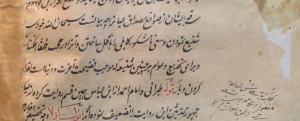
Example Two: On page 179b of the fair-copy manuscript, the text reads:
“لا غرو صدوره مثل هذه الدعاوي من هؤلاء…”
Whereas on page 587b of the draft manuscript, it reads:
“لا غرو صدور مثل هذه الدعاوي من هؤلاء…”
It is clear that the reading in the draft manuscript is the correct one.

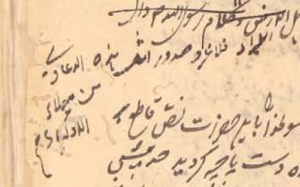
- B) Where the differences between the two manuscripts consist of corrections introduced during the preparation of the fair copy in order to revise the draft manuscript, the readings of the fair-copy manuscript are preferred and incorporated into the text. The completion of quotations, Allamah’s corrections, and his marginal additions to the fair-copy manuscript fall into this category. In such cases as well, the differences between the two manuscripts are not recorded in the footnotes.
For example, several lines on page 151a of the fair-copy manuscript have been crossed out, and the following note appears in the margin: “This was repeated and was therefore crossed out.”
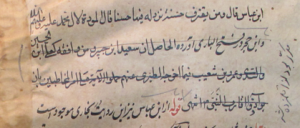
Research Method for Dealing with Variants between the Two Manuscripts
Marginal Notes in the Manuscripts
As noted in the section introducing the manuscripts, the fair-copy manuscript[28] contains several types of marginal notes. In the process of critical editing, a method appropriate to each type has been adopted:
Marginal notes marked with the sign “sahh” or with an “abru” mark have been incorporated into the main text.
Marginal notes that function as references to sources have been included neither in the main text nor in the footnotes, since many of the books available to Allamah are no longer accessible to us. Moreover, in the present study, all quotations and references are independently traced to the available sources.
Marginal notes relating to the research and collation process of the book, such as “Collated with Ansab al-Sam‘ani under the nisba al-Naqqash, in the letter nun with qaf” and “This was repeated and was therefore crossed out,” have been included neither in the text nor in the footnotes.
Marginal notes marked with the symbol “n,” indicating a variant reading, have been recorded in the footnotes.
Marginal notes marked with the symbol “lahu,” which concern the correction of scribal errors, have been incorporated into the main text in place of the erroneous readings.
Marginal notes containing translations of individual words have been recorded in the footnotes.
The very small number of marginal notes marked with the sign “fــــ” have been omitted from both the text and the footnotes, since they occur only in the opening section of the book and apparently their use was discontinued thereafter.
The marginal headings written at the top of the pages have been incorporated throughout the critical edition into the main text under seven headings, such as “The Verse (((إِنَّما وَلِيُّكُمُ اللّهُ)))” and “The Verse of Purification,” among others.
Marginal material relating to leaves pasted into the manuscript has likewise been incorporated into the main text.
Passages that had been crossed out have not been included in the present edition.
Deterioration and Difficulty in Reading the Manuscripts
Deterioration and termite damage in the two manuscripts, errors resulting from the limited literacy of the copyist of the fair-copy manuscript, and the draft nature of the text of the rough manuscript have, in some places, made it difficult to recover Allamah’s exact wording.
In such cases, the passages have not simply been left unintelligible or meaningless. Rather, an effort has been made to resolve obscurities through careful examination of the extant manuscripts, comparison with Allamah’s distinctive style, consultation of manuscript, lithographed, and letterpress sources, reference to dictionaries and biographical works, and the use of accumulated knowledge from rijal, Qur’anic exegesis, and hadith studies.
A number of examples may be cited:
- On page 33b of the fair-copy manuscript, the following appears:
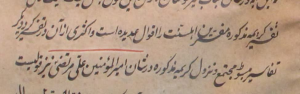
And on page 190a of the draft manuscript, the following appears:
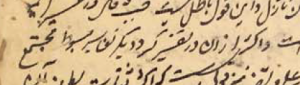
This passage was rendered as follows:
“And most of it is gathered in al-Tafsir al-Kabir and other extensive works of Qur’anic exegesis.”
- On page 41a of the fair-copy manuscript, there appears a phrase resembling “قاطنین کردانید”.
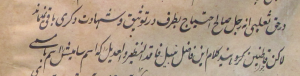
And on page 192b of the draft manuscript, the following appears:
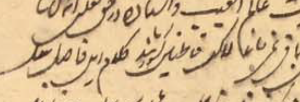
This passage was rendered as follows:
“After the statement concerning al-Tha‘labi, ‘Indeed, he is a righteous man,’ there remains no need for any further authority to attest to his reliability or bear witness to it. However, since the inhabitants[29] of India, and the words of this noble scholar—one without peer or equal, whose honored name truly corresponded to its bearer…”
- On page 115b of the fair-copy manuscript, the following appears:
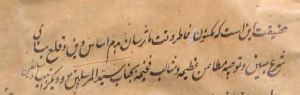
This passage was rendered as follows:
“The truth is that what lies concealed in their minds, as revealed by their meticulous writings, is the destruction of the very foundations of religion, the uprooting of the edifice of the manifest Shari‘a, and the directing of grave accusations and serious reproaches against the Master of the Messengers (peace and blessings be upon him and his family), the prophets of earlier times, the rightly guided Imams, the pious ascetics, and the scholars of previous generations.”
- On page 58a of the fair-copy manuscript, the following appears:
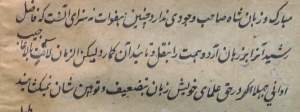
“Such lapses are not befitting of a learned and discerning scholar, nor should he devote his efforts to transmitting and endorsing them; yet time indeed brings forth wonders! Even the lowest among the ignorant do not open their tongues to weaken or insult their own scholars…”
- On page 128b of the fair-copy manuscript, the following appears:
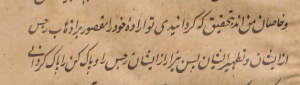
And on page 256b of the draft manuscript, the following appears:

This passage was corrected as follows:
“…and they are those especially close to me. Indeed, You have confined Your will to removing impurity from them and purifying them; so remove impurity from them and purify (them)[30] thoroughly…”
- B) Source Verification and Collation
Throughout the critical edition, Qur’anic verses, hadiths, and passages quoted from other works have been fully traced to their sources. This procedure has been followed even with lithographed and manuscript sources.
Where a source used by Allamah is no longer accessible to us, or where no sufficiently reliable copy is available, the loss or unavailability of the source has been noted in the footnote.
The hadiths and quotations appearing in the text have been carefully collated against their sources, and differences between the manuscript wording and the source have been reflected, as appropriate, either in the main text or in the footnotes.
Where the difference between the manuscript and the source consists of an addition or omission, this is indicated within the text. Material present in the manuscript but absent from the source is placed between angle brackets <…>, while material present in the source but absent from the manuscript is placed in parentheses (…).
Where the difference concerns a variant word or phrase, the variation is noted in a footnote.
The form of citation in the footnotes varies according to the nature of the source and the circumstances:
- A single-volume work is cited as follows: Basa’ir al-Darajat: 50.
- A work in two or more volumes is cited as follows: al-Kafi 2: 50.
- In hadith collections in which the traditions are numbered, the hadith number is given after the page number in the following form: Basa’ir al-Darajat: 50/33; that is, page 50, hadith 33.
- In works whose individual entries are numbered, the entry number is given after the page number, as follows: Fihrist al-Najashi: 70/no. 40.
- C) General Editorial Principles
- Abbreviations and sigla used in the manuscript have been expanded in the critical text. For example, forms such as “ایض”, “ح”, and “ع” have been rendered in full as “ایضا”, “حینئذ”, and “علیه السلام”, respectively.
- The page numbers of the fair-copy manuscript have been inserted before the first word of each page and enclosed in square brackets.
- Statements of the Infallibles (peace be upon them), whether in the main text or in the footnotes, are placed within the following quotation marks: ”…“
- The spelling of certain words has been modernized in accordance with contemporary orthographic conventions, despite the form found in the manuscript. For example, forms such as “درین”, “برینکه”, “کو”, “حالانکه”, and “فرقه” have been rendered as “در این”, “بر اینکه”, “گو”, “حال آنکه”, and “فرقهای”.[31]
- The prepositional particle ba has been written separately from the following word in accordance with contemporary orthographic practice. For example, “باختصار” is rendered as “به اختصار”.
- In cases where the text differs from the source, the wording found in the text is sometimes correct, while in other cases the source is correct; in still other cases, neither reading is correct. In such instances, the correct reading has been placed in the main text, while the incorrect form has been noted in a footnote. In some cases, the notation kadha (“thus”) has been used in the footnote to indicate that the wording in the text is obscure or incorrect.
- Difficult words occurring in Arabic and Persian passages have been sourced and explained. Where the word occurs in an Arabic passage, reference is made to Arabic lexicons; where it occurs in a Persian passage, reference is made to Persian dictionaries.
- If a word recurs several times within the same volume, it is documented only on its first occurrence, unless there is a particular reason to document it again.
- Additions made by the researcher in headings, the main text, and footnotes are placed within square brackets: […]. In some cases, a phrase or word was already enclosed in square brackets in the source itself;
where this occurs, it is noted in the footnote.
- D) Sigla and Symbols
The symbols used in the text are as follows:
< >: indicates material present in the manuscript but absent from the source.
( ): indicates material present in the source but absent from the manuscript.
[ ]: indicates additions made by the researchers.
M: in the footnotes, indicates the source.
S: in the footnotes, indicates the draft manuscript.
Ḍ: in the footnotes, indicates the fair-copy manuscript.
Mohammad Javad Rajabzadeh
27 August 2022
29 Muharram 1444 AH
[1]. It should be noted that, prior to the publication of the present work, another critical edition of the First Manhaj was unveiled. In an article entitled “Notes on the Critical Edition of the First Manhaj of Abaqat,” after presenting a selection of the shortcomings of that edition as examples of a much larger number, we demonstrated that the need for a new critical edition and scholarly study of the First Manhaj of the noble Abaqat still remained. Among the principal issues discussed in that article were numerous errors in reading the manuscript text, failure to collate the extant manuscripts accurately, failure to reproduce the manuscript text faithfully, and failure to compare many of the quotations carefully with their original sources.
[2]. A description of the two manuscripts, as well as some of the difficulties encountered in the critical edition, will be presented below.
[3]. This book has recently been revived and reprinted by the Research Institute of the International Foundation for Imamate.
[4]. Diya al-Ayn: 69–70.
[5]. al-Dhari‘a 15: 214.
[6]. See: Abaqat al-Anwar 23: 295; and Nafahat al-Azhar 1: 27.
[7]. Mawqif al-Shi‘a min Hujumat al-Khusum, Sayyid Abd al-Aziz Tabataba’i, Turathuna, Muharram 1407 AH, Year 2, no. 1, 30 pages, pp. 32–61.
[8]. It should be noted that no trace of a critique of the first doctrine is found anywhere in the extant manuscripts. Nevertheless, the possibility that a more complete manuscript once existed containing a critique of the first doctrine is not remote, particularly since the page numbering of the manuscript from which the fair copy was prepared, recorded at the top of the pages of the fair-copy manuscript, begins with number 101.
[9]. Tuhfa-yi Ithna ‘Ashariyya (Nasihat al-Mu’minin wa Fadihat al-Shayatin), Shah Abd al-Aziz ibn Shah Wali Allah Dehlavi, known as Ghulam Halim (d. 1239 AH), lithographed edition, Hasani Press, Delhi, 1271 AH.
[10]. The following section—“Introduction to the Manuscripts”—will provide the complete characteristics of all the extant manuscripts.
[11]. Another piece of evidence that may be cited is an inscription on the paper cover of one of the extant manuscripts relating to the critique of the six aforementioned doctrines in al-Tuhfa. It reads: “Abaqat al-Anwar, First Manhaj, transcription of the original from the Second Doctrine to the Fourth Doctrine.”
[12]. Abaqat al-Anwar, lithographed edition, 10: 65.
[13]. Ibid., 16: 167.
[14]. Ibid.: 154.
[15]. Ibid., 13: 153.
[16]. Ibid., 9: 119.
[17]. Ibid., 12: 489.
[18]. Ibid., 13: 167.
[19]. Ibid., 20: 78.
[20]. It should be noted that some pages from the end of the draft manuscript have been lost, but are preserved in this manuscript.
[21]. For example, in the margin of page 207b, alongside a quotation from al-Qawl al-Mustahsan, the following appears:
The denominator of this fraction indicates that the passage in question appears on page 188 of the copy available to the author, which consisted of 438 pages. The copy of al-Qawl al-Mustahsan available to us consists of 584 pages. This book has no table of contents, and its material is presented continuously, without section breaks or headings. Accordingly, locating the passage would ordinarily require reading the entire book.
However, by multiplying 188 by 584 and dividing the result by 438, we obtain the number 250, which provides the approximate location of the relevant passage in the edition available to us. By searching within that approximate range, the passage in question was located on page 267 of our copy.
[22]. Various interpretations have been offered for the symbol “12,” which appears at the end of some marginal notes and is more common in the hadith section of Abaqat al-Anwar. Among the meanings proposed for this symbol are hadd, tammat, and al-manqul. See: al-Jawhara al-‘Aziza, in Rasa’il fi Dirayat al-Hadith 2: 459–460; and Mu‘jam al-Rumuz al-‘Amma 1: 109–114.
[23]. Mu‘jam Tabaqat al-Mutakallimin 5: 73, no. 571.
[24]. Ibid.: 113, no. 590.
[25]. Surat al-Jumu‘a: 4.
[26]. Diya al-Ayn: 96.
[27]. The first half of the First Manhaj will soon be critically edited and researched at the Research Institute of the International Foundation for Imamate.
[28]. Since the marginal notes of the draft manuscript were incorporated into the text of the fair-copy manuscript, we have not discussed the marginal notes of the draft manuscript separately here.
[29]. Qatin [ṭi] (Arabic adjective): resident, inhabitant. Dehkhoda Dictionary 11: 17,374.
[30]. Added from the source.
[31]. In modern Persian orthography, when a word ending in a silent h—such as ferqa—is used in an indefinite construction, -i is added to the end of the word. This rule was not necessarily observed in the extant manuscripts or in older Persian orthography. For example, the present book reads: “تا به حدّى كه فرقه پيدا شد كه قائل به خلافت حضرت عبّاس بود”. Such instances have been corrected in accordance with contemporary Persian orthographic conventions.