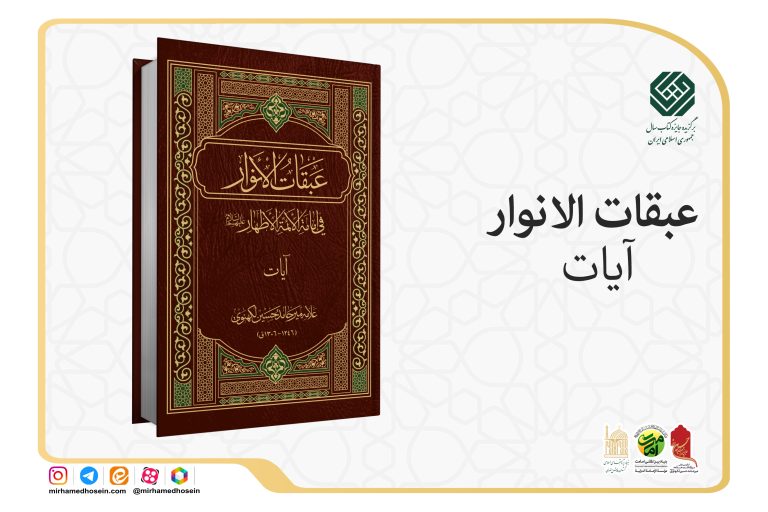
Re-examining the “Manhaj of the Verses” in ʿAbaqāt al-Anwār
Among the different sections of ʿAbaqāt al-Anwār, its “First Manhaj” holds a fundamental position in explaining the question of Imamate. This section, commonly known by the title “Verses,” may at first appear to be devoted solely to examining the verses that indicate Imamate; however, a more careful study of the structure of ʿAbaqāt shows that this understanding is incomplete and, to some extent, incorrect.
The Actual Structure of the First Manhaj
Allamah Mīr Ḥāmid Ḥusayn Lucknawī organized the First Manhaj of ʿAbaqāt into two distinct sections:
- First section: Theological discussions on Imamate. In this section, the foundations and arguments put forward among Sunnis for establishing the Caliphate are examined and criticized under several principal headings. This section is, in fact, a theoretical introduction to entering the discussion of Imamate and presents a general framework of the theological dispute concerning Imamate.
- Second section: Examination of the verses of Imamate. Subsequently, the Allamah turns to the verses that were disputed by ʿAbd al-ʿAzīz Dehlawī in the seventh chapter of Tuḥfat Ithnā ʿAshariyyah. In this section, the verses indicating the Imamate of Amīr al-Muʾminīn ʿAlī (peace be upon him) are examined in detail in terms of the authenticity of the reports concerning the circumstances of revelation and their indication, and the objections raised concerning them are answered.
Correcting a Common Assumption
In some accounts, it has been stated that the First Manhaj of ʿAbaqāt is entirely devoted to the verses of Imamate and that the division of ʿAbaqāt into the two Manhajs of Verses and Hadiths was influenced by the structure of the book Tuḥfat Ithnā ʿAshariyyah. However, a direct study of the work shows that the First Manhaj extends beyond the verses, and a considerable part of it is devoted to theological discussions and criticism of the foundations of the Caliphate. Therefore, an accurate understanding of this Manhaj is fundamentally necessary for understanding the argumentative methodology of the Allamah in ʿAbaqāt.
The Place of the “Verses” within the Overall ʿAbaqāt Project
The section on the verses is, in fact, the connecting link between the theoretical discussions of Imamate and the transmitted arguments presented in the Second Manhaj. In this section, the Allamah first explains the theoretical framework, then turns to the Qur’anic texts, and finally, in the Second Manhaj, expands the hadith-based arguments. This continuity demonstrates the systematic design of ʿAbaqāt in explaining the question of Imamate.
Revival and Publication
Despite the importance of this section, the “First Manhaj” of ʿAbaqāt had not, until recent years, been independently available to researchers. In the project to revive the works of Allamah Mīr Ḥāmid Ḥusayn, the “Verses” section of this work has been published through the collection of the available manuscripts and new research. This undertaking represents an important step toward re-examining the complete structure of ʿAbaqāt and making it accessible to contemporary researchers.
The “Verses” section in ʿAbaqāt al-Anwār is not merely a collection of interpretations of verses, but rather part of a comprehensive theological project in which the question of Imamate is examined through the connection between theoretical foundations, Qur’anic texts, and transmitted arguments. Re-examining this section can play an important role in gaining a more precise understanding of Allamah Mīr Ḥāmid Ḥusayn’s argumentative methodology and the overall structure of ʿAbaqāt al-Anwār.
For further acquaintance with the Verses section of ʿAbaqāt al-Anwār and the measures undertaken to revive this book, read the introductory article to this book written by its reviver.