Allamah Mir Hamid Husayn in “Masfā al-Maqāl”

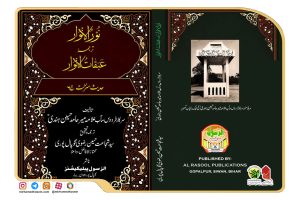
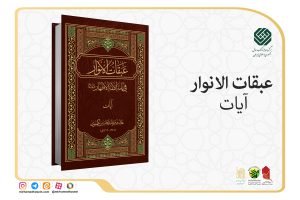
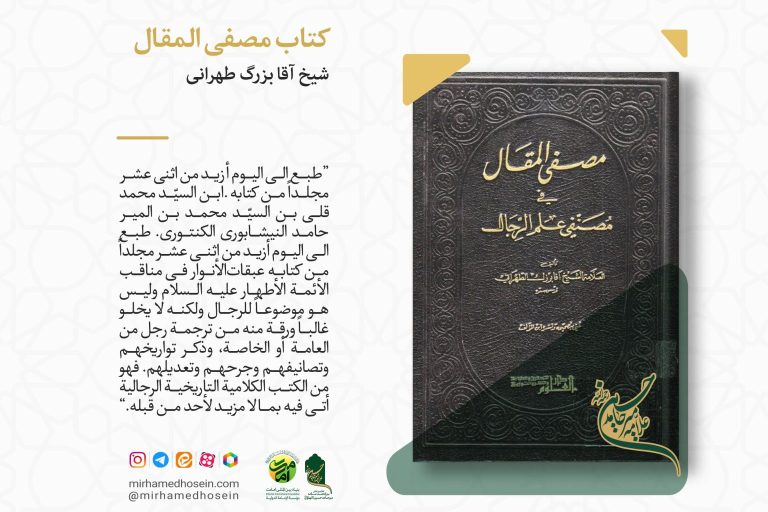
چکیده: He is al-Sayyid al-Mir Hamid Husayn, son of al-Sayyid Muhammad Quli, son of al-Sayyid Muhammad, son of al-Mir Hamid al-Nishapuri al-Kunturi. To this day, more than twelve volumes of his book, «عبقات الانوار فی مناقب ائمه الاطهار», have been published. Although the book is not specifically a subject of Ilm al-Rijal (the science of biographical evaluation), most of its pages contain biographies of individuals, whether common or elite, mentioning their dates, their works, and their *Jarh wa Ta'dil* (evaluation of reliability). Thus, it is one of those theological, historical, and biographical (Rijali) books that has achieved unparalleled depth.

Allamah Mir Hamid Husayn in “Masfā al-Maqāl”

## About the book “Masfā al-Maqāl”

“Masfā al-Maqāl fī Musannifī ‘Ilm al-Rijāl” is an Arabic work written by Agha Bozorg Tehrani (d. 1970). In this work, the author introduces the authors of Shia biographical (Rijali) books, providing a brief account of their lives and their scholarly works. The book includes biographies of 660 scholars of Ilm al-Rijal.

“Masfā al-Maqāl” is a detailed treatise on the biographies of the authors of Shia biographical books and their works. It lists figures from the era of the Minor Occultation up to the author’s time in alphabetical order, mentioning their books beneath their names. The author spent from 1900 to 1950 collecting and composing this work.
Leave a Comment

Your email address will not be published. Required fields are marked *

زندگی نامه

Allamah Mir Hamid Husayn in *Tabaqat A’lam al-Shia

He is al-Sayyid al-Amir Hamid Husayn ibn al-Amir Sayyid Muhammad ‘Ali (Muhammad Quli) ibn al-Sayyid Muhammad ibn Hamid Husayn al-Musawi al-Nishapuri al-Kunturi al-Hindi al-Lakhnawi. He is among the greatest Imami theologians and the most profound Shia scholars of the early 14th century. Born in Lucknow (1830), he grew up under his father’s guidance, mastering preliminary sciences. He studied *Kalam* (theology) under his father, Imam Sayyid Muhammad Quli, and *Fiqh* and *Usul* under “Sayyid al-‘Ulama’” Sayyid Husayn al-Naqawi.

زندگی نامه

Allamah Mir Hamid Husayn in “Masfā al-Maqāl”

He is al-Sayyid al-Mir Hamid Husayn, son of al-Sayyid Muhammad Quli, son of al-Sayyid Muhammad, son of al-Mir Hamid al-Nishapuri al-Kunturi. To this day, more than twelve volumes of his book, «عبقات الانوار فی مناقب ائمه الاطهار», have been published. Although the book is not specifically a subject of Ilm al-Rijal (the science of biographical evaluation), most of its pages contain biographies of individuals, whether common or elite, mentioning their dates, their works, and their *Jarh wa Ta’dil* (evaluation of reliability). Thus, it is one of those theological, historical, and biographical (Rijali) books that has achieved unparalleled depth.

زندگی نامه

Allamah Mir Hamid Husayn in “Ganjineh-ye Danesh-mandan

Allamah Mir Hamid Husayn held an exalted status. It is narrated that after his passing, a righteous man dreamed that the Day of Judgment had arrived, the Prophet (PBUH) was on a pulpit, and the Allamah was seated one step below, interceding for the sinners, and the Prophet (PBUH) accepted his intercession.

زندگی نامه

The Anecdote of the Allamah’s Absence from His Son’s Funeral

It is narrated that one of the Sayyid’s sons passed away, and he was informed to attend the funeral. The Sayyid was deeply affected by the death of his son, yet he instructed them to proceed with the shrouding and burial themselves, as he had no time to participate in the mourning.

زندگی نامه

Thesis: “A Study of the Position of Allamah Mir Hamid Husayn Hindi in the History of Shiism

Allamah Mir Hamid Husayn Hindi is one of the very great Shia scholars and the author of important theological works in the field of defending the domain of Shiism against the attacks of opponents, especially the refutation written by Shah Abd al-Aziz Dehlavi against the Shia under the title «تحفه اثنی عشریه». Through writing these books, especially «عبقات الانوار فی مناقب ائمه الاطهار», he was able to leave a lasting work of his own in the history of Shiism.

Scroll to Top