Allamah Mir Hamid Husayn in “Ganjineh-ye Danesh-mandan

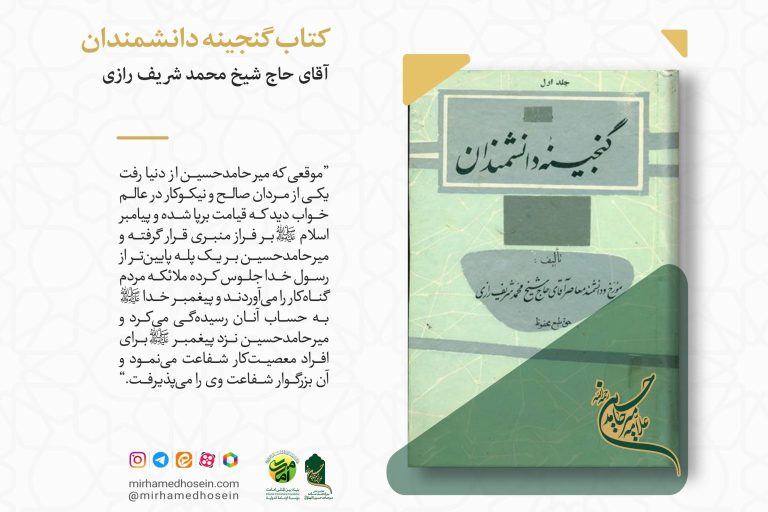
چکیده: Allamah Mir Hamid Husayn held an exalted status. It is narrated that after his passing, a righteous man dreamed that the Day of Judgment had arrived, the Prophet (PBUH) was on a pulpit, and the Allamah was seated one step below, interceding for the sinners, and the Prophet (PBUH) accepted his intercession.

Allamah Mir Hamid Husayn in “Ganjineh-ye Danesh-mandan”

 About “Ganjineh-ye Danesh-mandan”

This nine-volume work by Mohammad Sharif-Razi (1922–2000) documents the biographies of Shia scholars, as well as the history of cities, libraries, and seminaries in Iran.

 Lucknow

A major religious and scientific city in India, known for its diverse scholarly atmosphere. The library of Allamah Mir Hamid Husayn, author of «عبقات الانوار», is among its most significant cultural landmarks.

 Biography of Allamah Mir Hamid Husayn

The Great Mujahid Allamah Sayyid Mir Hamid Husayn (born 1830, died 1888) was among the greatest Imami theologians. He is the author of the invaluable «عبقات الانوار فی مناقب ائمه الاطهار» and «استقصاء الإفحام». He rendered monumental services to the defense of Shiism and was highly praised by scholars such as Allamah Amini and the author of «الذریعة».

 Anecdote of the Rare Manuscript

It is narrated that the Allamah discovered a manuscript needed to refute the «تحفه اثنی عشریه» (by Shah Abd al-Aziz Dehlavi) held by a scholar in the village of Rabouq (between Mecca and Medina). After his Hajj pilgrimage, the Allamah traveled there, staying with the scholar under the guise of a traveler. Through immense patience and dedication, he copied the entire manuscript by night. Upon receiving the news of this, the scholar in Rabouq was astonished by the Allamah’s determination and succumbed to grief over the loss of the manuscript’s exclusivity.


Thesis: “A Study of the Position of Allamah Mir Hamid Husayn Hindi in the History of Shiism

Leave a Comment

Your email address will not be published. Required fields are marked *

Research Resources

A Brief Survey of the Ḥadīth of Ghadīr in ʿAbaqāt al‑Anwār

Despite the many discussions surrounding the Ḥadīth of Ghadīr throughout history, before the writing of ʿAbaqāt al‑Anwār one cannot find a work that has addressed all aspects of this ḥadīth in detail and responded to the various objections of the Sunnīs regarding its chain (isnād) and implication (dalāla). Indeed, the efforts of ʿAllāma Mīr Ḥāmid Ḥusayn al‑Hindī were not limited to responding to the objections of ʿAbd al‑ʿAzīz al‑Dehlawī; rather, by tracing the roots of the doubts, he used Dehlawī’s statements as a basis for presenting and critiquing the statements of earlier Sunnī scholars, leaving behind a comprehensive and solid work. May Allah have mercy upon him and grant him a good abode.

Notes

Re-examining the “Manhaj of the Verses” in ʿAbaqāt al-Anwār

Among the different sections of ʿAbaqāt al-Anwār, its “First Manhaj” holds a fundamental position in explaining the question of Imamate. This section, commonly known by the title “Verses,” may at first appear to be devoted solely to examining the verses that indicate Imamate; however, a more careful study of the structure of ʿAbaqāt shows that this understanding is incomplete and, to some extent, incorrect.

Notes

Re-examining “Hadith al-Ghadir” in ʿAbaqāt al-Anwār

Among the textual proofs related to the question of Imamate, Hadith al-Ghadir holds a special position. This hadith, which has been transmitted with the well-known wording, “Whoever I am his mawla, then this ʿAlī is his mawla,” is among the traditions that have received extensive attention from Muslim scholars throughout history. However, a comprehensive and methodical examination of this hadith requires extensive investigation across various sources and a precise analysis of both its chain of transmission and its indication.

Notes

Re-examining “Hadith al-Wilayah” in ʿAbaqāt al-Anwār

The examination of “Hadith al-Wilayah” in ʿAbaqāt al-Anwār is a clear example of Allamah Mīr Ḥāmid Ḥusayn’s scholarly methodology; a methodology in which extensive investigation, precise analysis of chains of transmission, and multilayered analysis of indication are brought together.

Scroll to Top