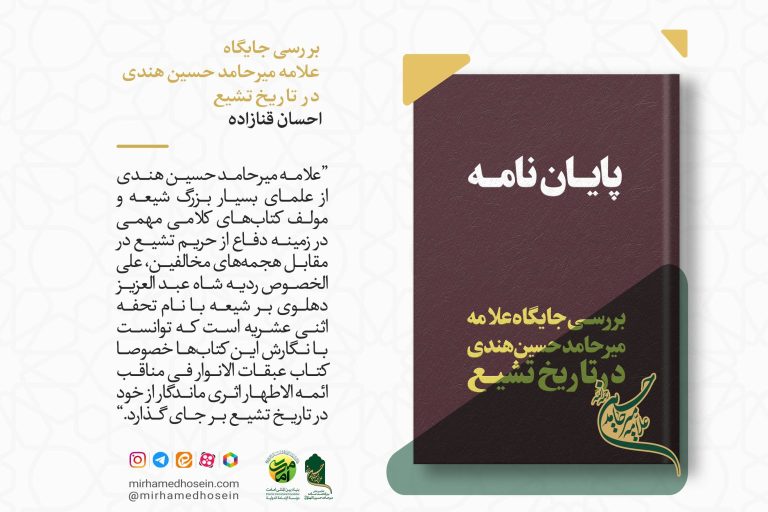
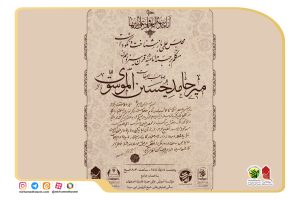
Thesis: “A Study of the Position of Allamah Mir Hamid Husayn Hindi in the History of Shiism

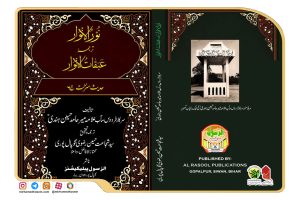
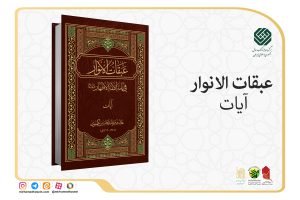
چکیده: Allamah Mir Hamid Husayn Hindi is one of the very great Shia scholars and the author of important theological works in the field of defending the domain of Shiism against the attacks of opponents, especially the refutation written by Shah Abd al-Aziz Dehlavi against the Shia under the title «تحفه اثنی عشریه». Through writing these books, especially «عبقات الانوار فی مناقب ائمه الاطهار», he was able to leave a lasting work of his own in the history of Shiism.

Thesis: “A Study of the Position of Allamah Mir Hamid Husayn Hindi in the History of Shiism”

Abstract:

Allamah Mir Hamid Husayn Hindi is one of the very great Shia scholars and the author of important theological works in the field of defending the domain of Shiism against the attacks of opponents, especially the refutation written by Shah Abd al-Aziz Dehlavi against the Shia under the title «تحفه اثنی عشریه». Through writing these books, especially «عبقات الانوار فی مناقب ائمه الاطهار», he was able to leave a lasting work of his own in the history of Shiism.

 Title

A Study of the Position of Allamah Mir Hamid Husayn Hindi in the History of Shiism

 Level

Master’s Degree

 Educational Center

Faculty of Theology, Payam Noor University

 Supervisor

Dr. Asghar Qaedan

 Advisor

Dr. Karim Najafi Barzegar

 Author

Ehsan Qannazadeh

 Keywords

Allamah Mir Hamid Husayn Hindi, History of Shiism in India, عبقات الانوار, Lucknow, آل عبقات

 Abstract

Allamah Mir Hamid Husayn Hindi is one of the very great Shia scholars and the author of important theological books in the field of defending the domain of Shiism against the attacks of opponents, especially the refutation written by Shah Abd al-Aziz Dehlavi against the Shia under the title «تحفه اثنی عشریه». Through writing these books, especially «عبقات الانوار فی مناقب ائمه الاطهار», he was able to leave a lasting work of his own in the history of Shiism.

Lucknow, which was the center of the government of the Nawabs of Awadh, suffered in the time of Allamah Mir Hamid Husayn from much political, social, and even religious disorder. This was because the weakness of the Nawab government, and consequently the increase of colonial influence on the one hand, and the religious propaganda of other religions and sects and their refutation-writing against Shiism on the other hand, had created difficult conditions for the Shias of India.

In such circumstances, Allamah Mir Hamid Husayn rose to defend the sanctity of the Ahl al-Bayt. Although other books were written by Shia scholars, and even by scholars of Mir Hamid Husayn’s own family, in refutation of Shah Abd al-Aziz’s «تحفه», none of them was able to have such a profound impact on the Shia society of India and other Islamic lands.

This very scholarly and intellectual support of the Allamah for the Shias of India caused him to leave behind an enduring role in the history of Shia civilization. The family of Mir Hamid Husayn Hindi also rendered many services in the direction of spreading Shia teachings, and the book «عبقات الانوار» is considered one of them.

Studying the scholarly and practical conduct of this great Shia scholar and explaining the services of the family of عبقات can, while honoring his struggles in defense of Shia thought, play an important role in creating a scholarly and ethical model for researchers.

Leave a Comment

Your email address will not be published. Required fields are marked *

Research Resources

A Brief Survey of the Ḥadīth of Ghadīr in ʿAbaqāt al‑Anwār

Despite the many discussions surrounding the Ḥadīth of Ghadīr throughout history, before the writing of ʿAbaqāt al‑Anwār one cannot find a work that has addressed all aspects of this ḥadīth in detail and responded to the various objections of the Sunnīs regarding its chain (isnād) and implication (dalāla). Indeed, the efforts of ʿAllāma Mīr Ḥāmid Ḥusayn al‑Hindī were not limited to responding to the objections of ʿAbd al‑ʿAzīz al‑Dehlawī; rather, by tracing the roots of the doubts, he used Dehlawī’s statements as a basis for presenting and critiquing the statements of earlier Sunnī scholars, leaving behind a comprehensive and solid work. May Allah have mercy upon him and grant him a good abode.

Notes

Re-examining the “Manhaj of the Verses” in ʿAbaqāt al-Anwār

Among the different sections of ʿAbaqāt al-Anwār, its “First Manhaj” holds a fundamental position in explaining the question of Imamate. This section, commonly known by the title “Verses,” may at first appear to be devoted solely to examining the verses that indicate Imamate; however, a more careful study of the structure of ʿAbaqāt shows that this understanding is incomplete and, to some extent, incorrect.

Notes

Re-examining “Hadith al-Ghadir” in ʿAbaqāt al-Anwār

Among the textual proofs related to the question of Imamate, Hadith al-Ghadir holds a special position. This hadith, which has been transmitted with the well-known wording, “Whoever I am his mawla, then this ʿAlī is his mawla,” is among the traditions that have received extensive attention from Muslim scholars throughout history. However, a comprehensive and methodical examination of this hadith requires extensive investigation across various sources and a precise analysis of both its chain of transmission and its indication.

Notes

Re-examining “Hadith al-Wilayah” in ʿAbaqāt al-Anwār

The examination of “Hadith al-Wilayah” in ʿAbaqāt al-Anwār is a clear example of Allamah Mīr Ḥāmid Ḥusayn’s scholarly methodology; a methodology in which extensive investigation, precise analysis of chains of transmission, and multilayered analysis of indication are brought together.

Scroll to Top