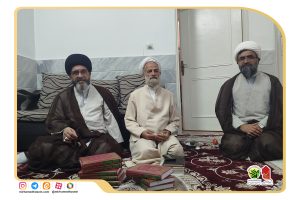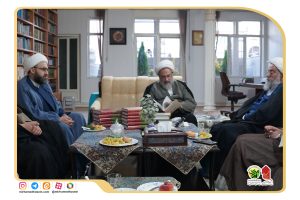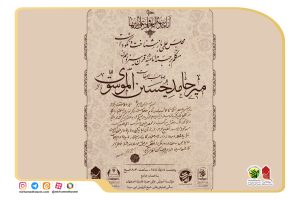
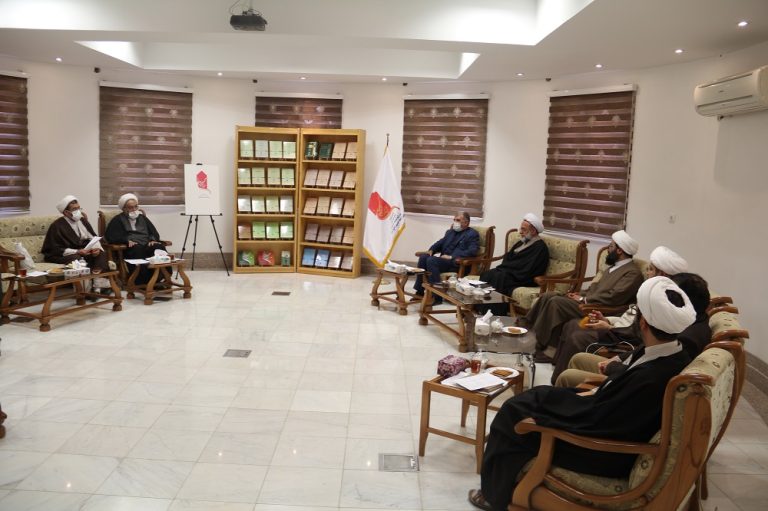
According to the Secretariat of the International Congress Commemorating Allama Mir Hamid Husayn (RA), Dr. Ahad Faramarz Qaramaleki, the head of Astan Quds Razavi Research Foundation, along with his accompanying delegation, visited the officials of the Congress Secretariat to enhance mutual cooperation.
The meeting, held on Tuesday, December 7, 2021, began with a welcome to the guests. The honorable president of the Congress, Hujjat al-Islam wal-Muslimin Dr. Sobhani, outlined the policies and objectives of the Secretariat. He stated:
“Initially, the focus of the Secretariat’s activities was on the works of Allama Mir Hamid Husayn and introducing the Lucknow School. However, with increasing participation, the scope expanded to the extent that collaborating institutions are now engaged in reviving the Shi’a heritage in the Indian subcontinent.”
Dr. Sobhani noted that the late Imam Khomeini (RA) and the Supreme Leader (may his shadow endure) placed special emphasis on reviving the works of Allama Mir Hamid Husayn. He added:
“Over these years, the Secretariat’s primary effort has been the revival of the intellectual legacy of the scholars of the Lucknow theological-jurisprudential school.”
The Congress president mentioned that the revival of Abaqat al-Anwar initially began with the support of the Supreme Leader (may his shadow endure) at Astan Quds Razavi Research Foundation. However, due to the project’s prolonged nature, collaborations were established with the Foundation’s former officials, leading to the formation of research groups at the Imamate Foundation and the training of manuscript restoration specialists. As a result, not only has Abaqat al-Anwar been fully restored, but other rare manuscripts have also been revived.
Hujjat al-Islam wal-Muslimin Sobhani expressed hope that under the new management of Astan Quds Razavi Research Foundation, further collaborations would strengthen the Secretariat’s academic activities.
Next, Hujjat al-Islam wal-Muslimin Kazemi, the Congress Secretary, presented an overview of the Secretariat’s initiatives, mentioning that eight pre-conferences had been held domestically and internationally, two of which were organized with the support of Astan Quds Razavi Research Foundation.
He highlighted ongoing research projects related to Allama Mir Hamid Husayn, including biographical studies, correspondences, methodological analyses, and bibliographic works. He stressed the necessity of introducing scholars to the resources of the Lucknow School, as many researchers lack familiarity with them. A comprehensive catalog of works related to Islam and Shi’ism in India, particularly those concerning the Abaqat family and scholarly traditions, has been compiled and will soon be published on the Congress website and in an upcoming reference book.
The Secretary also noted efforts to guide specialized theses at Level 3 and 4 in Shi’a seminaries, with two doctoral dissertations on Allama Mir Hamid Husayn already supported.
Hujjat al-Islam wal-Muslimin Esfandiyari (Scientific Secretary of the Congress) introduced the restored works, stating that 45 books have been processed for revival, including Imad al-Islam by Ayatollah al-Uzma Mujaddid al-Shari’a Ghufran Ma’ab, a seminal theological text of Shi’ism. Other notable works include Asas al-Usul, Muntaha al-Afkar, and writings by other scholars of the Lucknow School.
Hujjat al-Islam wal-Muslimin Mokhtari, head of the Shi’a Bibliographic Institute and a member of the Congress’s policy-making council, presented 12 volumes on the bibliographies of Lucknow School scholars, such as Awarq al-Dhahab and A’ina-ye Haqnuma.
Hujjat al-Islam wal-Muslimin Mahdipour, the Supreme Leader’s representative in India, provided insights into India’s scholarly history, particularly in Lucknow, and emphasized the need for continued collaboration between the Congress Secretariat and Astan Quds Razavi Research Foundation.
In his concluding remarks, Dr. Qaramaleki expressed his admiration for Abaqat al-Anwar and the painstaking work of manuscript restoration, an often-overlooked academic endeavor. He affirmed the Foundation’s commitment to preserving Shi’a heritage, aligning with the Supreme Leader’s vision of civilizational revival in the “Second Phase of the Revolution.”
He announced that, with the blessings of the Custodian of Astan Quds Razavi, cooperation with the Congress would be streamlined, and the Foundation would fully support its initiatives. Dr. Qaramaleki invited the Congress officials to further meetings at the Foundation to explore additional collaborative opportunities.