Volume Six of the Urdu Translation of ʿAbaqāt al-Anwār, Focusing on Hadith al-Manzilah, Published
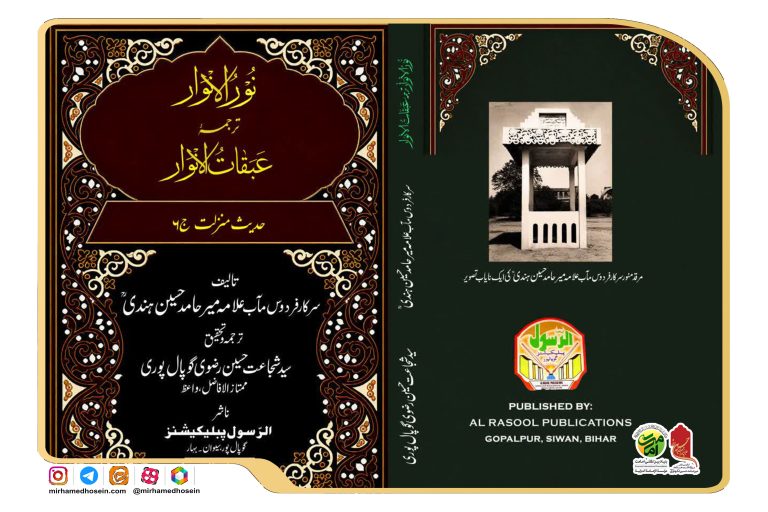
Continuing the scholarly and cultural efforts to translate and republish the enduring heritage of Allamah Mīr Ḥāmid Ḥusayn Lucknawī in the Indian subcontinent, the sixth volume of the “Nūr al-Anwār; Translation of ʿAbaqāt al-Anwār” collection, in Urdu and focusing on “Hadith al-Manzilah,” has been published.
This work has been translated into Urdu by Mawlānā Sayyid Shujāʿat Ḥusayn Razavī Gopālpūrī, and al-Rasūl Publications in Gopālpur, Siwan District, Bihar State, India, has undertaken its publication. According to the information printed on the book’s cover, the translator is one of the seminary scholars and Urdu-speaking preachers and holds the title “Mumtāz al-Afāḍil Wāʿiẓ.”
The present book is the sixth volume of the “Nūr al-Anwār” collection; a collection compiled with the aim of conveying parts of the monumental book “ʿAbaqāt al-Anwār fī Imāmat al-Aʾimmah al-Aṭhār” into Urdu. In the available online catalogs, the five previous volumes of this collection are listed as Hadith al-Thaqalayn in two volumes, Hadith al-Safīnah, Hadith al-Tashbīh, and Hadith al-Nūr. With the publication of the section on Hadith al-Manzilah, the number of volumes in this collection has reached six.
ʿAbaqāt al-Anwār is one of the most important theological works on the subject of Imamate and among the most prominent writings of Allamah Mīr Ḥāmid Ḥusayn Mūsavī Lucknawī. This book was written in response to the section on Imamate in the book “Tuḥfah-yi Ithnā ʿAshariyyah,” and in it, the author, making extensive use of the hadith, rijāl, historical, exegetical, and theological sources of the Sunnis, examined the chains of transmission and indications of the hadiths related to Imamate and the virtues of the Ahl al-Bayt (peace be upon them). One of the characteristics of Allamah Mīr Ḥāmid Ḥusayn’s methodology is the separation of discussions concerning the chain of transmission and indication, and argumentation on the basis of the sources and rules accepted by the opposing audience.
The new volume of “Nūr al-Anwār” is devoted to the famous Hadith al-Manzilah; a hadith in which the Messenger of Allah (peace and blessings of Allah be upon him and his family), addressing Amīr al-Muʾminīn (peace be upon him), says: “أنتَ مِنّی بِمَنزلةِ هارونَ مِنْ مُوسی، إلّا أنّه لا نَبیّ بَعدی”; that is, your position in relation to me is the same as the position of Hārūn in relation to Mūsā, except that there will be no prophet after me.
Hadith al-Manzilah has been transmitted in numerous Shiʿa and Sunni sources, including Ṣaḥīḥ al-Bukhārī and Ṣaḥīḥ Muslim. The most famous context of its utterance goes back to the Battle of Tabūk; however, reports of the expression of this meaning on other occasions, such as the pact of brotherhood, the events of Khaybar, and the incident of closing the doors, have also been mentioned in hadith and historical sources. Imāmī scholars regard this hadith as one of the important proofs for the special position, virtue, and succession of Amīr al-Muʾminīn ʿAlī (peace be upon him).
In the original structure of ʿAbaqāt al-Anwār, the discussion of Hadith al-Manzilah is the second volume of the Second Manhaj of the book; however, the number six in the present publication indicates the order of publication of the Urdu translation of “Nūr al-Anwār.” This difference in numbering is because the sections of ʿAbaqāt in the Urdu collection have not been published according to the original order of the book.
The publication of this volume, in addition to introducing another important section of ʿAbaqāt al-Anwār to Urdu-speaking audiences, demonstrates the continued attention of institutions and researchers of the Indian subcontinent to the scholarly heritage of Allamah Mīr Ḥāmid Ḥusayn; a heritage which, after more than a century, continues to be translated, researched, and republished in the scholarly, doctrinal, and cultural sphere of the Shiʿa world.
This book is not among the productions or revived works of the International Congress for the Commemoration of Allamah Mīr Ḥāmid Ḥusayn, and has been independently published in India; nevertheless, due to its direct connection with ʿAbaqāt al-Anwār and the scholarly heritage of the author of ʿAbaqāt, its publication is taken into consideration within the framework of introducing activities and efforts related to Allamah Mīr Ḥāmid Ḥusayn.
Bibliographic Information
Book title: Nūr al-Anwār; Translation of ʿAbaqāt al-Anwār, Volume Six
Volume subject: Hadith al-Manzilah
Author: Allamah Mīr Ḥāmid Ḥusayn Mūsavī Hindī
Translator: Mawlānā Sayyid Shujāʿat Ḥusayn Razavī Gopālpūrī
Language: Urdu
Publisher: al-Rasūl Publications
Place of publication: Gopālpur, Siwan, Bihar, India
Relation to the Congress: An independent work related to the scholarly heritage of Allamah Mīr Ḥāmid Ḥusayn